Four-Post Car Lift for Wheel Alignment: Which Runway, Turntable, and Jacking Features Matter?
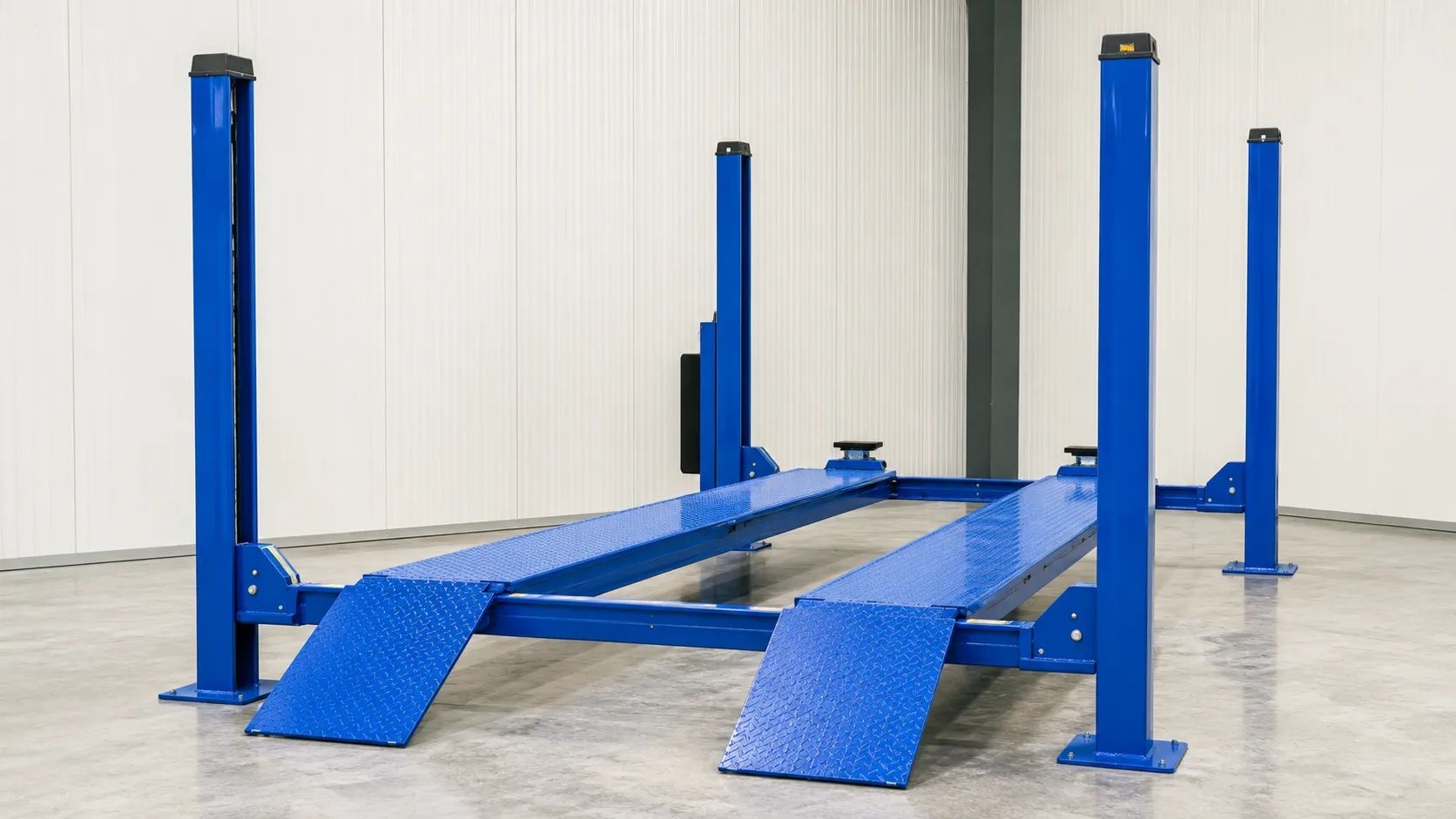
Direct Answer: A four post car lift is suitable for wheel alignment only when the complete rack configuration matches the workshop’s vehicle mix and alignment workflow. Buyers should verify usable runway length and width, wheelbase and track coverage, front turntable provisions, rear slip-plate provisions, rolling-jack requirements, drive-on access, bay dimensions, floor and power conditions, and whether those alignment components are actually included in the quoted model.
This question matters to tire shops, automotive repair workshops, 4S/dealer service centers, fleet maintenance facilities, equipment distributors, and OEM buyers adding or replacing an alignment bay. A standard four-post service or parking lift may raise the same vehicles as an alignment rack but still lack the runway geometry, turntable pockets, rear slip plates, wheel-free lifting, or installation provisions required for a smooth alignment workflow.
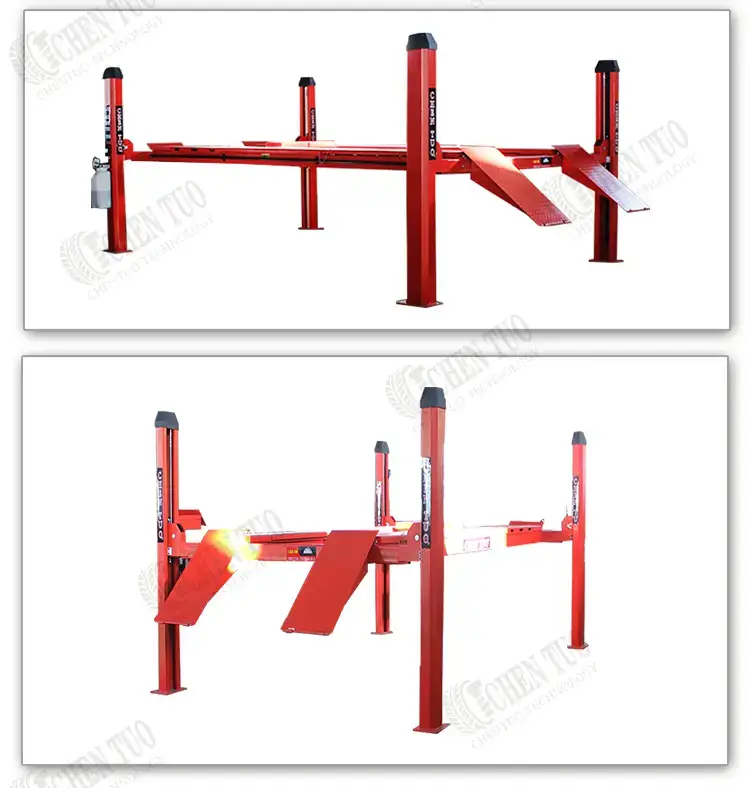
Chentuo supplies car lifts for workshop applications, including the CT609 four-post hydraulic and electric car lift. The current product data confirms a four-post lift configuration, but it does not by itself confirm that turntables, rear slip plates, rolling jacks, or other alignment hardware are included. Those items must be verified in the quotation and product drawing.
When Is a Four-Post Lift Actually Suitable for Wheel Alignment?
A lift becomes alignment-suitable when it does more than support the vehicle. It must allow the front wheels to steer freely during caster sweep, allow the rear suspension to settle laterally during alignment procedures, keep the vehicle stable and level at the working position, and support the workshop’s wheel-free service steps when required.
| Lift Configuration | Typical Workshop Use | Alignment Procurement Risk |
| Standard four-post service lift | Inspection, service, general underbody work | May not provide turntable pockets, slip plates, or alignment-specific runway geometry. |
| Four-post lift prepared for alignment hardware | Alignment after compatible hardware is installed | Buyer must confirm exactly which turntables, slip plates, locks, fillers, and jacks are compatible. |
| Complete alignment-rack configuration | Dedicated wheel-alignment bay | Still requires vehicle-envelope, bay, floor, power, and workflow verification. |
Industry experience point: “Four-post” describes the lift architecture, not the alignment capability. A buyer who assumes every four-post lift is alignment-ready may discover the missing hardware only after installation.
How Should Vehicle Wheelbase and Track Width Define the Runway?
Start with the workshop’s actual vehicle inventory. Record the shortest and longest wheelbase, the narrowest and widest track, vehicle width, gross/service weight range, tire width, low-clearance vehicles, and any light-commercial vehicles that must use the same bay.
The lift runway must support the tires through the full drive-on and service position. The front alignment hardware must sit where the front axle can reach it, and the rear wheels must remain within the useful slip-plate area for the intended wheelbase range.
- Usable runway length, not only overall lift length
- Runway width and spacing range
- Minimum and maximum alignment wheelbase supported by the final configuration
- Vehicle track-width coverage
- Ramp approach angle for low vehicles
- Clearance for bumpers, spoilers, exhausts, or long overhangs
- Vehicle weight distribution, not only total vehicle weight
Industry experience point: A lift can have enough rated capacity but still be a poor fit for the shop’s longest-wheelbase vehicle or narrowest track. Capacity and vehicle envelope are separate decisions.
Which Turntable Provisions Must Buyers Confirm?
Front turntables allow the steered wheels to move during alignment procedures. The buyer should not simply ask whether “turntables are available.” The quotation should state whether turntable pockets are built into the runway, whether turntables are included or optional, their usable position range, how they are locked and unlocked, how fillers are handled when alignment is not being performed, and whether the selected turntables fit the intended alignment system.
The workshop should also confirm whether the front axle positions of its shortest and longest vehicles can be centered correctly on the turntables without unsafe vehicle placement on the runways.
Industry experience point: Turntable position is an equipment-interface issue. A turntable can be perfectly functional but still be unusable for a particular vehicle mix if the rack geometry does not place the front axle where the alignment procedure needs it.
Why Do Rear Slip Plates Matter?
Rear slip plates allow the rear wheels to move laterally as suspension and alignment adjustments are made. Without the appropriate slip-plate function, the vehicle may not settle naturally after adjustments, which can undermine the workshop process even if the alignment machine itself is accurate.
For purchasing, confirm the rear slip-plate location and usable travel, how the plates are locked for drive-on/drive-off, whether they are part of the quoted lift, and whether the supported wheelbase range matches the shop’s vehicles.
The alignment equipment and lift should be evaluated together. Chentuo’s wheel alignment equipment category represents the measuring side of the bay, while the lift must provide the mechanical vehicle position and movement required by the selected alignment workflow.
When Are Rolling Jacks Required?
A four-post rack supports the vehicle by the tires, which is ideal for many alignment steps. However, workshops often also need the wheels free for tire, brake, suspension, steering, or undercar service. Rolling bridge jacks can lift one axle from the runway without removing the vehicle from the alignment bay.
- Whether wheel-free service is part of the bay workflow
- How many rolling jacks are required
- The axle loads those jacks must handle
- The jack’s usable lift-point range
- Whether adapters are required for different vehicle frames
- How the jack is powered and moved along the runway
- Whether the jack is included, optional, or sourced separately
Industry experience point: Buyers sometimes specify lift capacity carefully but leave rolling-jack capacity undefined. The bay then supports the vehicle on the runways but cannot safely perform the intended wheel-free step.
How Should Service Mix Change the Lift Configuration?
| Workshop Service Mix | Priority Features to Verify | Reason |
| Alignment only | Turntable and slip-plate compatibility, runway coverage, level working position | Alignment movement and vehicle positioning dominate the workflow. |
| Alignment + tire/brake service | Rolling jacks, tool access, air/power routing, technician access | Vehicle must move from wheel-supported to wheel-free work without changing bays. |
| Passenger + SUV mix | Runway spacing, tire width, wheelbase range, ramp clearance | The rack must cover both narrow/light and larger vehicles. |
| Passenger + light commercial | Wheelbase, axle-load/jack requirements, runway width, bay clearance | Larger vehicles can expose geometry and support limits before total lift capacity is reached. |
| High-throughput alignment bay | Fast plate locking/unlocking, convenient jacking, easy drive-on and technician movement | Small workflow delays repeat on every vehicle. |
The correct configuration depends on the bay’s revenue model. A shop doing occasional alignment after general service has different priorities from a dedicated tire and alignment center processing many vehicles per day.
How Do Approach Ramps and Bay Dimensions Affect the Purchase?
The workshop should map the entire vehicle path from the shop entrance to the final alignment position. Check door width and height, turning space, ramp length, approach angle, lift overall dimensions, column positions, technician walkways, alignment-camera or target clearance, tool cabinets, power units, and the space needed to use rolling jacks.
Low-clearance vehicles may require longer or lower-angle approach ramps. Long vehicles may fit on the runways but still conflict with the bay wall, alignment camera, or entrance door.
Industry experience point: A lift can fit on the floor plan and still fail the real bay layout because the vehicle cannot turn onto the ramps or because the alignment equipment loses the required working distance.
What Floor and Installation Inputs Belong in the RFQ?
The buyer should provide the available installation area, floor construction and condition, slab/foundation information required by the equipment supplier, floor levelness, drainage or pits, ceiling height, local electrical supply, and any compressed-air requirement created by optional jacks or accessories.
Do not copy floor or anchoring requirements from another lift model. The final installation basis must come from the selected model’s approved manual or supplier drawing.
Chentuo has previously published guidance on car lift leveling risk. For a new alignment bay, leveling should be treated as part of installation acceptance rather than a correction left until alignment results appear inconsistent.
Scenario: A Workshop Buys a Four-Post Lift but Still Cannot Perform Full Alignment Service
Representative scenario — not a claimed Chentuo customer case.
Business Background: A tire shop serving passenger cars, SUVs, and light vans plans to add a wheel-alignment bay. The buyer selects a four-post lift because its rated vehicle capacity appears sufficient.
Problem: After installation, the shop discovers that the lift was supplied as a general service configuration. Front turntables were not included, the rear runways lack the required slip-plate setup, and the shop has no rolling jack for wheel-free suspension work.
Cause: The RFQ specified lift type and capacity but did not include the workshop’s vehicle envelope, alignment hardware, rolling-jack workflow, or included-versus-optional accessory list.
Solution: For the revised purchase, the shop issues a configuration matrix covering wheelbase/track range, runway dimensions, turntable positions, rear slip plates, rolling jacks, bay layout, floor data, power/air, and alignment-equipment interface. The supplier must mark every item as included, optional, incompatible, or requiring further confirmation.
Buyer Decision Value: The workshop buys an alignment bay as one operating system rather than treating the lift, plates, jacks, and aligner as unrelated equipment.
What Should Buyers Normalize Across Four-Post Lift Quotations?
| RFQ Field | Supplier Response Needed | Why It Matters |
| Lift model and rated configuration | Exact model, lift capacity, drawing/manual reference | Prevents comparing generic product families. |
| Usable runway dimensions | Length, width, spacing and supported vehicle envelope | Confirms vehicle fit. |
| Turntables | Included/optional, pocket size/location, lock method, compatibility | Confirms front alignment function. |
| Rear slip plates | Included/optional, location and supported wheelbase range | Confirms rear suspension movement. |
| Rolling jacks | Quantity, capacity, lift-point range, adapters, power source | Confirms wheel-free service. |
| Installation | Floor/foundation, power, air, anchoring and commissioning requirements | Prevents site rework. |
| Documentation | Manuals, drawings, parts list, warranty and acceptance records | Supports installation and after-sales service. |
What Should Buyers Put in the Four-Post Car Lift RFQ?
Send the workshop service mix, vehicle makes/classes, minimum and maximum wheelbase, track-width range, maximum vehicle and axle loads, tire widths, low-clearance requirements, desired runway dimensions, turntable/slip-plate requirement, rolling-jack quantity and capacity, bay dimensions, approach path, floor/foundation information, electrical supply, compressed air where applicable, target documentation, destination, and expected installation/commissioning scope.
Ask Chentuo to state which alignment-related features are included in the proposed configuration and which are optional. Do not infer that a four-post model is alignment-ready from the lift architecture alone.
Frequently Asked Questions
Can any four-post car lift be used for wheel alignment?
No. A four-post lift may be used for general service without the turntable, rear slip-plate, runway, leveling, or jacking provisions required by the workshop’s alignment process.
Why are front turntables used on an alignment lift?
They allow the steered wheels to move during alignment procedures such as steering/caster sweep. The exact turntable specification and position must match the lift and vehicle range.
Why are rear slip plates important?
They allow the rear wheels and suspension to settle laterally during alignment adjustment. Buyers should verify that the plates cover the intended wheelbase range and are included in the quote.
Do I need one or two rolling jacks?
It depends on the workshop workflow. If the bay must perform front- and rear-axle wheel-free work without moving the vehicle, two jacks may be appropriate, but quantity and capacity must be confirmed for the vehicle mix.
Is lift capacity enough to select runway size?
No. Vehicle wheelbase, track width, tire width, overhang, axle load, and approach geometry can limit suitability before total vehicle weight does.
How should a workshop verify that a Chentuo lift is alignment-ready?
Request the exact model drawing or configuration sheet showing turntable pockets, slip plates, runway dimensions, compatible jacks, and included accessories. The current CT609 product listing alone should not be treated as proof of alignment hardware.
What information should be sent for a quotation?
Send vehicle-envelope data, service mix, runway needs, alignment hardware, rolling-jack requirements, bay and floor conditions, power/air data, documentation requirements, destination, and installation expectations.
Request an Alignment-Bay Configuration Review
For a four-post alignment-bay quotation, send Chentuo the vehicle wheelbase, track and weight ranges, service mix, required turntables and slip plates, rolling-jack needs, bay layout, floor/foundation data, power and air conditions, alignment-equipment interface, documentation needs, and destination through the Contact Us page. Chentuo can review its car-lift range against those inputs and identify which lift and accessory items still need confirmation before the order is released.