How to Change Run-Flat and Low-Profile Tires Without Damaging the Rim
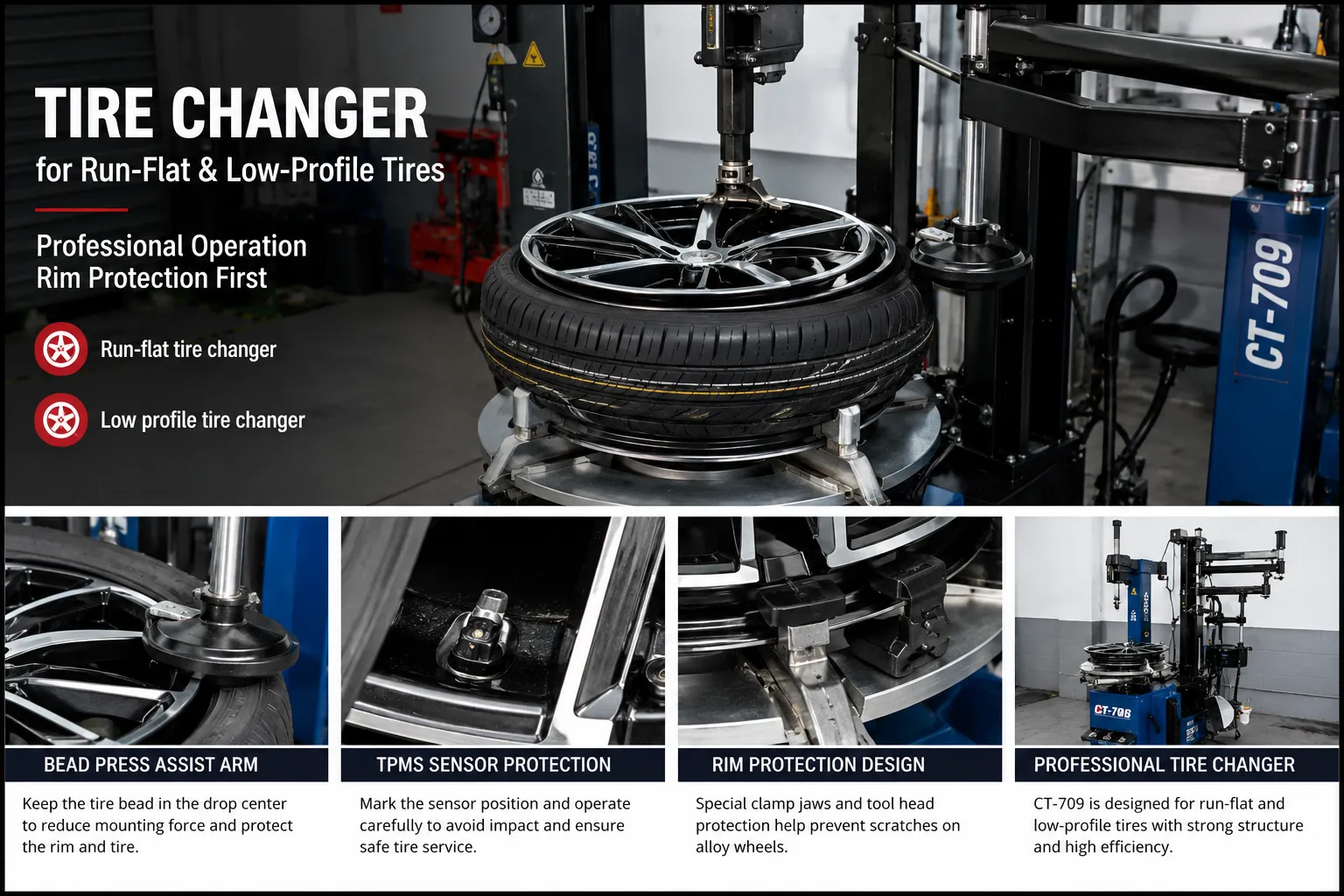
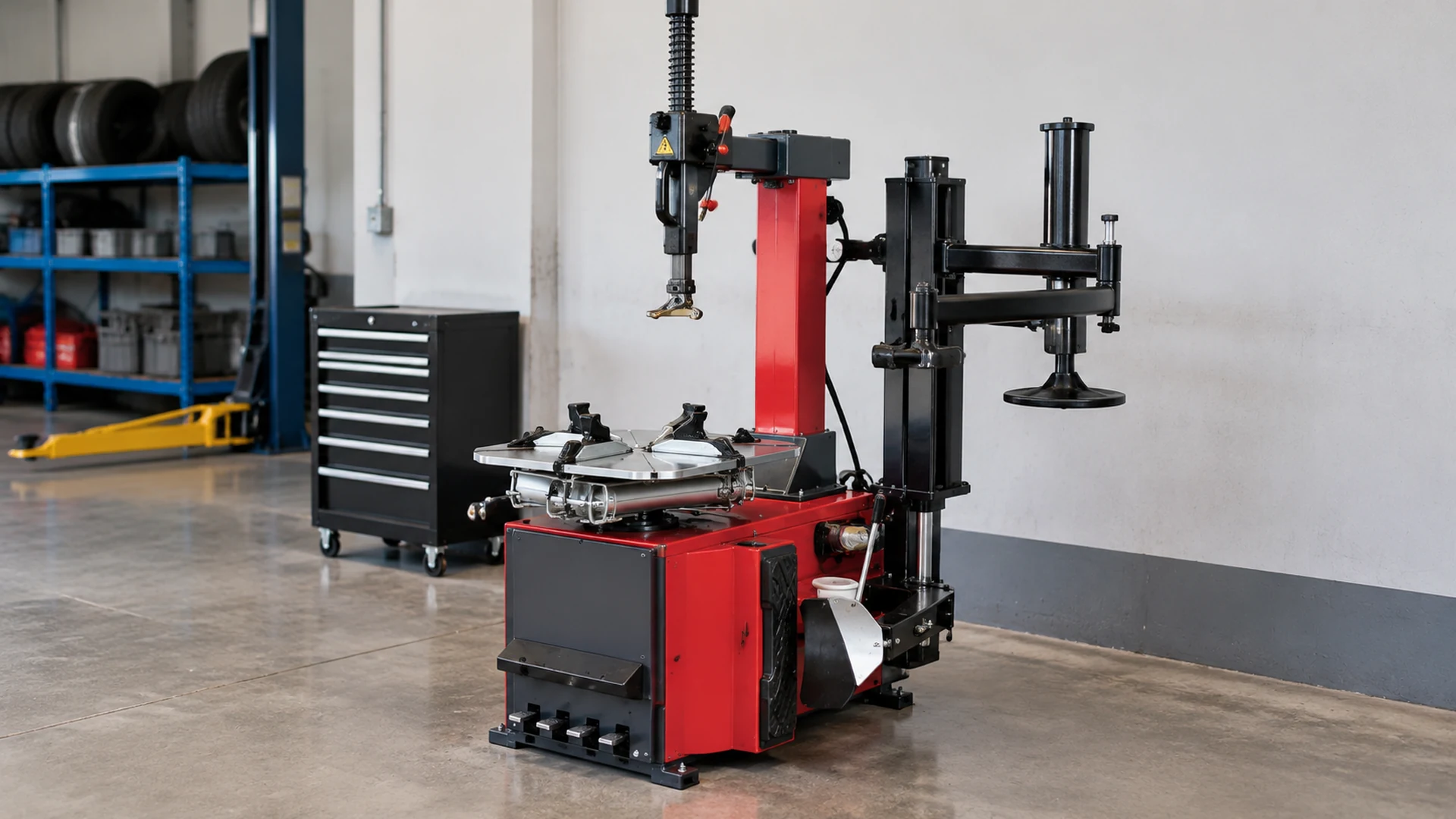
Run-flat and low-profile tires should be serviced by trained technicians using a tire changer with strong bead-breaking force, an assist arm or bead press, reliable rim protection, and controlled mounting speed. These tires have stiff sidewalls and limited flexibility, so forcing the bead with an ordinary lever or allowing it to climb out of the rim’s drop center can scratch alloy wheels, tear the bead, or damage the TPMS sensor. The most important factors are correct wheel clamping, full bead lubrication, keeping the opposite bead in the drop center, and controlling the tool head around the valve position. This guide explains the equipment features to look for, the correct demounting and mounting sequence, common causes of rim damage, quality checks after service, and the commercial details repair shops and distributors should confirm before buying a run-flat tire changer.
Why Are Run-Flat and Low-Profile Tires More Difficult to Change?
A conventional passenger car tire normally has enough sidewall flexibility to move over the wheel flange with moderate force. Run-flat and low-profile tires behave differently.
Run-flat tires have reinforced sidewalls designed to support the vehicle temporarily after a loss of air pressure. Their stiffer construction makes the tire bead more difficult to press into the wheel’s drop center.
Low-profile tires have a short sidewall compared with the width of the tread. The limited sidewall movement leaves less room for the technician to stretch and guide the bead during mounting and demounting.
These tire and wheel combinations frequently involve:
- Large-diameter alloy or performance wheels
- Painted, polished, chrome-plated or diamond-cut rim surfaces
- Stiff tire beads and reinforced sidewalls
- Direct TPMS sensors mounted near the valve
- Limited clearance between the tool head and the wheel
- Higher replacement costs if the rim, bead or sensor is damaged
For workshops that regularly service performance vehicles, luxury cars, SUVs or modified wheels, an ordinary entry-level machine may require excessive manual force. A professional tire changer with an assist arm and suitable protective components provides better control.
What Features Should a Run-Flat Tire Changer Have?
Not every machine marketed as an automatic tire changer is suitable for frequent run-flat or low-profile tire service. Buyers should evaluate the complete operating system rather than looking only at motor power or price.
1. Assist Arm or Full Bead Press System
The assist arm presses the sidewall downward and keeps the tire bead inside the wheel’s drop center. This reduces the tension placed on the section of bead passing over the mount and demount head.
For very stiff tires, multiple pressing points are more effective than relying on one roller. A synchronized bead press also helps reduce sudden bead movement, operator fatigue and uncontrolled contact with the wheel.
2. Controlled Bead-Breaking Force
The bead breaker must provide enough force to separate a stiff bead without requiring repeated impacts. However, force alone is not enough.
The technician must be able to control the blade position and prevent it from contacting:
- The rim flange
- The valve stem
- The TPMS sensor
- A previously damaged section of the tire
A machine with adjustable or multi-stage bead-breaking pressure gives the operator better control when switching between standard tires and reinforced run-flat assemblies.
3. Leverless or Rim-Protected Tool Head
Traditional metal tire levers can scratch a finished alloy wheel when used incorrectly. A leverless mount and demount system reduces the need to insert a metal bar between the bead and the rim.
When a conventional tool head is used, it should have replaceable plastic or polymer protection at all possible contact points. Rim protectors and protected clamps should also be inspected regularly and replaced before they become worn through.
4. Suitable Clamping Range
The machine’s internal and external clamping ranges must match the wheels normally serviced by the workshop.
Do not assume that a machine described as a 24-inch tire changer can process every 24-inch tire and wheel assembly. Buyers should also confirm:
- Maximum wheel diameter
- Maximum wheel width
- Maximum wheel weight
- Turntable clearance
- Assist-arm working range
- Bead-breaker opening width
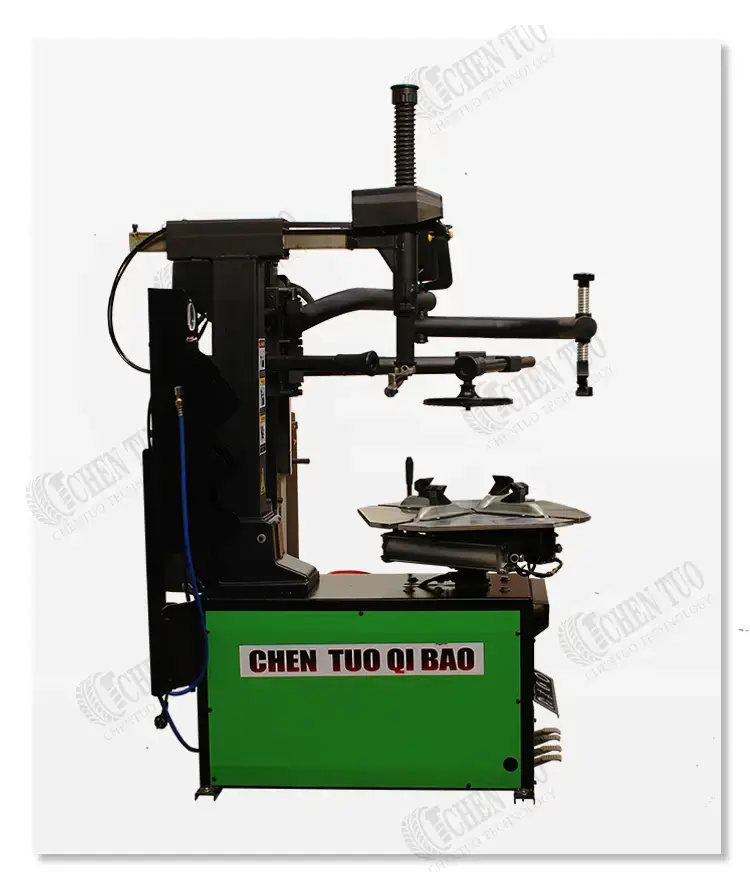
Chentuo’s CT-709 tire changer is listed with compatibility for rims up to 24 inches and is designed for professional tire service applications.
5. Controlled Rotation Speed
Low-profile tires should not be forced around the wheel at excessive speed. Controlled rotation allows the technician to stop immediately when the bead begins to rise out of the drop center or abnormal resistance appears.
A two-speed system can improve productivity, but the slower setting is generally more appropriate when beginning a difficult mounting or demounting operation.
6. TPMS Awareness
Many modern vehicles use a direct TPMS sensor attached to the valve stem or mounted inside the wheel.
Before operating the bead breaker or rotating the tire, the technician should identify and mark the sensor position. The tool head, bead breaker and tire bead must then be controlled according to the machine manufacturer’s and vehicle manufacturer’s procedures.
How Should Run-Flat and Low-Profile Tires Be Demounted?
Tire mounting and demounting should only be performed by trained professionals using approved equipment. Always follow the operating manual supplied with the tire changer and the service instructions provided by the tire or vehicle manufacturer.
Step 1: Inspect the Tire and Wheel
Before removing the tire, record or inspect:
- Tire size and wheel diameter
- Directional or asymmetric markings
- Valve and TPMS sensor position
- Existing scratches, cracks or flange damage
- Tire bead condition
- Evidence that the run-flat tire was driven without sufficient air
- Wheel weights or accessories that may interfere with clamping
Photographing pre-existing wheel damage can help repair shops avoid disputes after service.
A run-flat tire that has been driven underinflated may have internal damage that is not visible from the outside. It should be inspected internally after removal before being approved for reuse.
Step 2: Fully Deflate the Tire
Remove the valve cap and valve core to release all air before bead breaking. Confirm that the tire is fully deflated.
Never attempt to break the bead while the assembly remains pressurized.
Step 3: Apply Approved Tire Lubricant
Apply a suitable tire-mounting lubricant evenly to the bead and relevant rim contact areas. Insufficient lubrication increases friction, which can cause:
- Bead tearing
- Excessive stretching
- Sudden release of the tire
- Tool slippage
- Scratches on the rim
- Longer service time
Do not substitute petroleum-based grease or other unapproved chemicals. They may affect rubber components or leave contamination inside the tire.
Step 4: Break the Bead Carefully
Position the bead-breaker blade close to the rim without allowing it to strike the flange. Avoid the marked valve and TPMS sensor area.
Work progressively around the tire instead of using excessive pressure at one location. Repeat the process on the opposite side until both beads are completely released.
Step 5: Clamp and Protect the Wheel
Use the appropriate internal or external clamping method for the wheel design. Ensure that protective covers are installed on the clamps and tool head.
Before rotation, verify that:
- The wheel is centered
- All clamps are fully engaged
- The finished face is protected
- The wheel cannot move on the turntable
- The tool head has the required clearance from the rim
Step 6: Demount the Upper Bead
Position the tool head according to the machine instructions. Use the assist arm to push the bead opposite the tool head into the drop center.
Rotate the turntable slowly. Stop immediately if:
- The bead climbs out of the drop center
- The wheel moves in the clamps
- The sidewall becomes excessively stretched
- The tool head contacts the rim
- Abnormal resistance develops
Reposition the bead press and add lubricant instead of applying more uncontrolled force.
Step 7: Demount the Lower Bead
The lower bead can be more difficult because the operator has less visibility. Maintain bead control, track the TPMS sensor position and use the machine’s lifting or assist components where available.
Avoid pulling the lower bead across the finished wheel surface.
How Should the Tire Be Mounted Without Scratching the Rim?
Before mounting, confirm that the replacement tire matches the wheel diameter and is suitable for the vehicle. Inspect the bead, inner liner and rim sealing surfaces for damage or contamination.
Mount the Lower Bead
Lubricate both tire beads and the wheel’s bead seats. Position the lower bead over the tool head and begin rotation at a controlled speed.
The section opposite the tool head must remain in the drop center. Use the assist arm instead of forcing the bead with a metal lever.
Mount the Upper Bead
The upper bead normally requires more control because tire tension increases as the final section approaches the wheel flange.
Use the bead press to maintain downward pressure at one or more points. Continue only while the bead moves smoothly.
If resistance increases sharply:
- Stop the machine.
- Check whether the opposite bead remains in the drop center.
- Reposition the assist arm.
- Apply more approved lubricant if required.
- Confirm that the tire and wheel sizes match.
Do not solve excessive resistance by increasing speed or forcing the tire with an unprotected tool.
Inflate and Seat the Beads Safely
Follow the tire, wheel and equipment manufacturers’ inflation procedures and pressure limits. Keep hands, tools and other objects away from the bead area during inflation.
Once both beads are correctly seated:
- Adjust pressure to the vehicle manufacturer’s specification
- Reinstall or service the valve components as required
- Check for air leakage
- Confirm the TPMS sensor has not been damaged
- Inspect the bead around the complete circumference
- Clean lubricant residue from the wheel
- Balance the wheel before returning it to service
What Common Mistakes Cause Rim or Tire Damage?
Using an Entry-Level Machine for Frequent Difficult Tires
A basic machine may be able to process an occasional low-profile tire, but regular run-flat work without a suitable assist arm can increase service time and operator fatigue.
Workshops should match the tire changer to their real workload rather than purchasing solely on the lowest initial price.
For a comparison of entry-level and professional equipment, read Don’t Choose the Wrong Tire Changer for Your Auto Repair or Tire Shop.
Allowing the Bead to Leave the Drop Center
This is one of the most common causes of excessive resistance. When the opposite bead rises onto the bead seat, the effective diameter increases and the tire can no longer pass safely over the flange.
Using Insufficient Lubricant
Dry beads create friction and require much greater force. The result may be bead damage, tool slippage or rim contact.
Using Worn Protection Components
Plastic inserts, clamp covers and rim protectors are consumable parts. Once worn, the metal beneath them may contact the wheel.
These parts should be included in routine equipment inspections and spare-parts planning.
Ignoring the TPMS Sensor Position
Damage can occur when the bead breaker, tool head or moving bead contacts the sensor. Marking and monitoring its position is essential throughout the process.
Continuing When Resistance Is Abnormal
A professional operator stops and diagnoses the cause. Excessive resistance may indicate poor lubrication, incorrect tire size, improper tool positioning or failure to keep the bead in the drop center.
How Do You Choose a Low Profile Tire Changer for Your Workshop?
Before requesting a quotation, define the actual service requirements of your business.
Tire and Wheel Range
Provide the supplier with:
- Minimum and maximum rim diameter
- Maximum tire width
- Maximum complete wheel diameter
- Typical wheel weight
- Percentage of run-flat and low-profile work
- Passenger car, SUV, light truck or motorcycle applications
Daily Workload
A workshop processing several difficult tires per day needs a more durable machine and more efficient assist system than a shop handling occasional standard passenger tires.
Daily workload affects the required:
- Motor and turntable configuration
- Cylinder durability
- Assist-arm design
- Cooling and duty cycle
- Spare-parts inventory
- Operator efficiency
Workshop Utilities
Confirm the available:
- Electrical voltage and frequency
- Single-phase or three-phase supply
- Compressed-air pressure and flow
- Floor space
- Door and unloading dimensions
- Local electrical plug requirements
Do not order a machine until the voltage, frequency and air requirements have been confirmed in writing.
Operator Skill Level
A leverless system can reduce manual levering and help protect expensive wheels, but no machine removes the need for training.
Ask whether the supplier provides:
- Operating manuals
- Installation guidance
- Training videos
- Troubleshooting support
- Spare-parts diagrams
- Remote technical assistance
What Commercial Details Should Buyers Confirm?
International buyers, equipment distributors and repair-shop owners should request a complete technical and commercial quotation rather than comparing only the machine price.
| Item | Information to Confirm |
|---|---|
| Machine capacity | Rim clamping range, maximum wheel diameter, width and weight |
| Main construction | Frame structure, turntable, cylinders, clamps and replaceable protective parts |
| Bead system | Bead-breaker force, assist-arm configuration and pressure control |
| Electrical specification | Voltage, phase, frequency and motor power |
| Air requirement | Required pressure, airflow and connection size |
| Certification | Model-specific CE documents or other certificates required by the destination market |
| Quality control | Electrical test, pneumatic leak test, rotation test, clamping test and pre-shipment inspection |
| Packaging | Export wooden case, internal fixing, moisture protection and package dimensions |
| MOQ | Minimum quantity for the selected model, accessories and customized branding |
| Lead time | Stock availability, production schedule and inspection time |
| Customization | Voltage, plug, color, logo, labels, manual language and accessory package |
| Warranty | Warranty period, covered components and claim procedure |
| Spare parts | Recommended spare-parts list, prices and future availability |
| Shipping | Gross weight, package size, loading method, port and Incoterms |
Chentuo lists its CT-709 with CE certification, a 220V configuration and wooden-case packaging. Buyers should still confirm the final configuration, certificate documents, accessories and destination-market requirements for each order.
What Determines the Price of a Run-Flat Tire Changer?
The price is influenced by more than wheel capacity. Major factors include:
- Fixed-column or tilt-back design
- Single or multiple assist arms
- Lever-type or leverless tool head
- One-speed or two-speed turntable
- Bead-breaker force and pressure control
- Rim and clamp protection package
- Bead-blaster or inflation system
- Motor, cylinders and pneumatic component quality
- Voltage and plug customization
- Included accessories and spare parts
- Certification requirements
- Order quantity
- Packaging and international shipping costs
A lower purchase price may not produce the lowest operating cost. Repair shops should also calculate technician time, potential rim-damage claims, replacement-part availability and equipment downtime.
How Can Buyers Evaluate a Tire Changer Supplier?
Before placing an order, ask the supplier to provide:
- A complete technical specification sheet
- Photos or videos showing run-flat and low-profile tire operation
- Details of the bead press and rim-protection system
- A list of included and optional accessories
- Quality inspection procedures
- Warranty and spare-parts terms
- Packaging photos and shipping data
- References for similar export markets
- Confirmation of voltage and air requirements
- A written production and delivery schedule
A reliable supplier should be able to explain which machine fits the buyer’s wheel range and workload instead of simply recommending the most expensive model.
Frequently Asked Questions
Can a Standard Tire Changer Handle Run-Flat Tires?
Some standard machines can process occasional run-flat tires when fitted with a suitable assist arm and used by an experienced technician. For regular run-flat work, a machine designed with stronger bead control, rim protection and controlled operation is a better choice.
Is a Leverless Tire Changer Completely Damage-Free?
A leverless system reduces the risk created by inserting a metal tire lever near the rim. It does not eliminate damage caused by incorrect clamping, poor lubrication, worn protectors, incorrect tool positioning or operator error.
Why Must the Tire Bead Stay in the Drop Center?
The drop center provides the additional clearance needed for the opposite section of the bead to pass over the wheel flange. If the bead rises out of this area, tension increases rapidly.
How Often Should Rim Protectors Be Replaced?
Inspect them before regular operation and replace them whenever they become worn, cracked, loose or thin enough to expose metal components.
Choose the Right Tire Changer for Difficult Tire Service
Changing run-flat and low-profile tires safely depends on the combination of suitable equipment, correct bead control, approved lubrication, rim protection and trained operation.
When requesting a machine recommendation, send Chentuo the following information:
- Required rim-size range
- Largest tire width and wheel diameter
- Estimated daily service volume
- Percentage of run-flat and low-profile tires
- Available voltage and compressed-air supply
- Required quantity
- Destination country or port
- Preferred accessories and customization
Contact Chentuo to receive a suitable tire changer recommendation, technical configuration, packaging details and quotation for your workshop or distribution market.