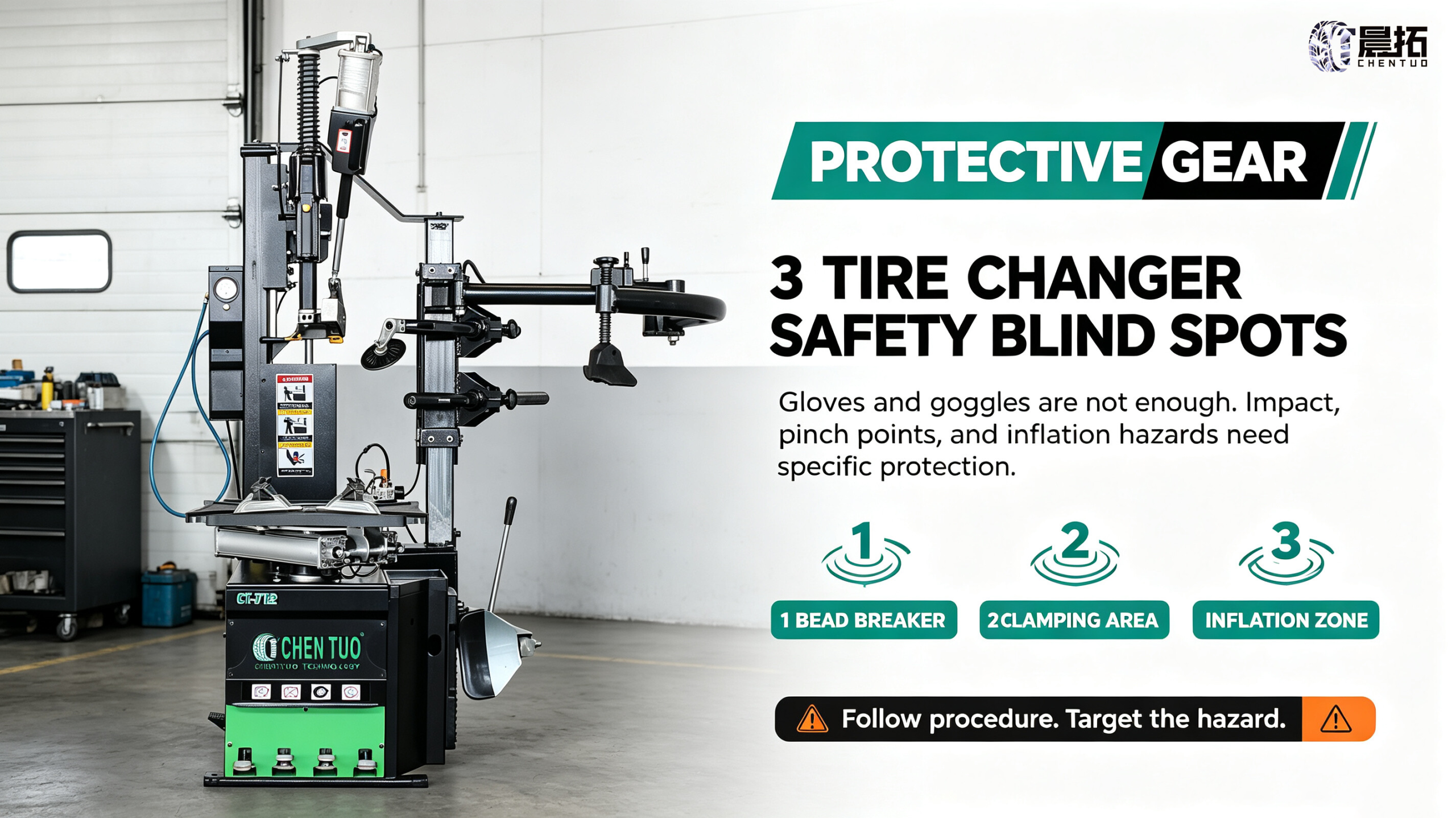
How to Choose a Heavy-Duty Truck Tire Changer for a Commercial Workshop
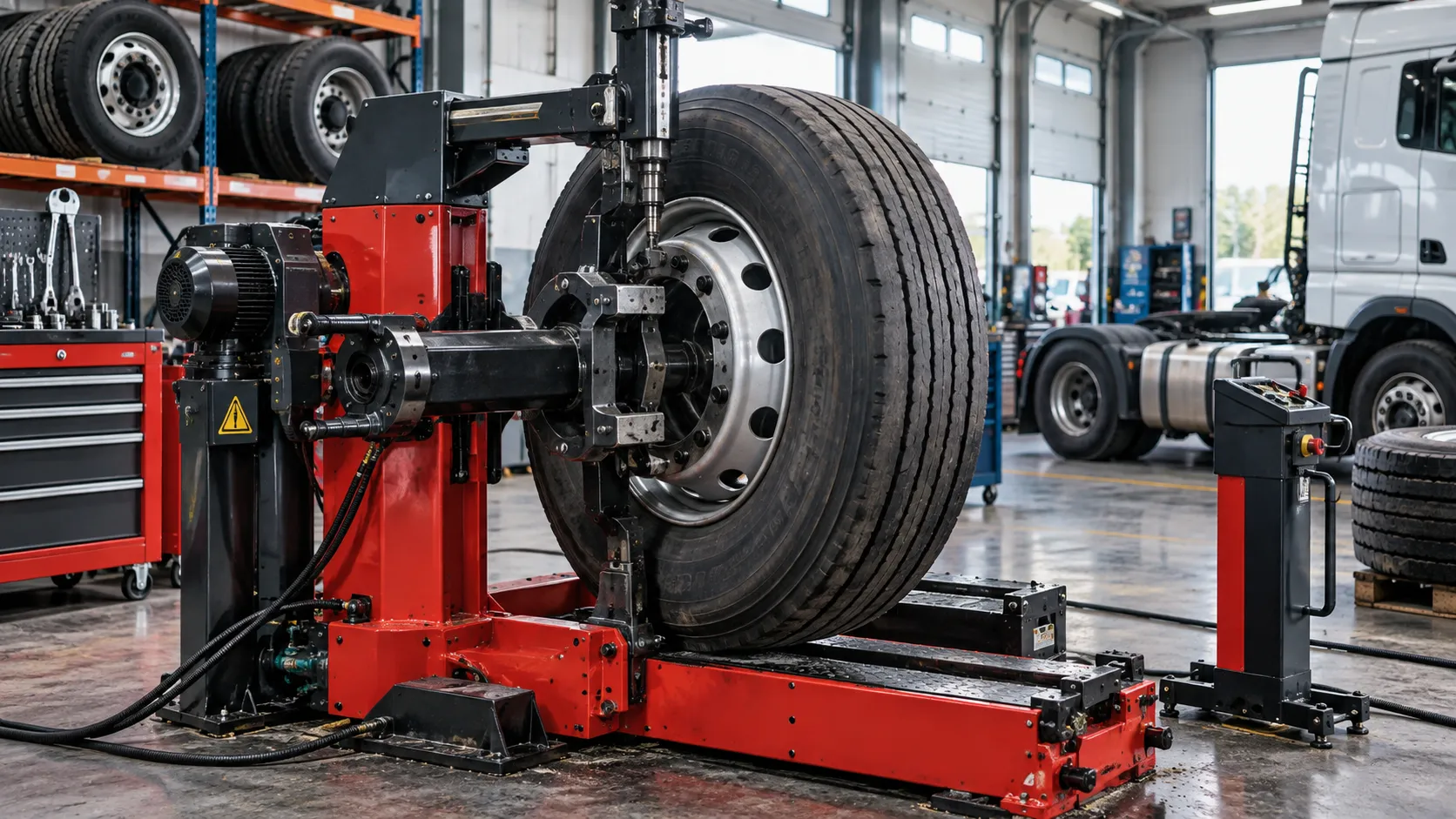
A heavy-duty truck tire changer should be selected from the workshop’s actual tire service envelope, not from the words “heavy duty” in a product title. Buyers should first identify the largest wheel and rim sizes they regularly service, then evaluate the machine’s working range, wheel-holding method, bead-breaking capability, assisted tire-handling functions, power and pneumatic requirements, installation footprint, and expected daily workload.
For a commercial truck workshop, maximum capacity is only one part of the decision. A machine that can physically accept a large wheel may still be inefficient if mounting, bead breaking, repositioning or tire handling requires too much technician time. Conversely, buying the largest machine available can create unnecessary cost and space requirements when oversized wheels represent only a small percentage of the shop’s work.
The right machine is therefore the one whose usable operating range matches the workshop’s real wheel mix and service volume.
Start With the Largest Tire Your Workshop Actually Services
“Truck tire” is not a complete equipment specification.
A commercial workshop may service:
- light commercial vehicles;
- medium-duty trucks;
- buses;
- heavy trucks;
- fleet vehicles;
- agricultural or engineering tires.
These applications can place very different demands on the tire changer.
Before comparing machines, build a simple service-envelope table from actual workshop records.
| Workshop Input | What the Buyer Should Record |
|---|---|
| Largest rim diameter | Maximum rim regularly serviced |
| Largest overall wheel diameter | Complete tire-and-wheel envelope |
| Typical tire range | Sizes representing most daily work |
| Largest tire width | Physical working-space requirement |
| Tire type | Commercial truck, bus, agricultural, engineering, etc. |
| Difficult tire types | Stiff beads or other high-effort jobs |
| Daily tire volume | Normal and peak workload |
| Utility availability | Voltage and compressed-air conditions |
A workshop should pay particular attention to the word regularly.
If 90% of daily jobs fall within one range and an extremely large wheel appears only a few times each year, the economic decision may differ from that of a specialist heavy-truck tire center handling large assemblies continuously.
This creates the first important trade-off:
Maximum possible coverage versus practical daily utilization.
The machine should cover the workshop’s required application boundary without creating unnecessary capital, floor-space or operating complexity.
Rim Diameter Alone Does Not Define Compatibility
A common purchasing question is:
“What rim size can the machine handle?”
That is important, but incomplete.
Wheel compatibility is multidimensional.
| Wheel Characteristic | Why It Matters |
|---|---|
| Rim diameter | Defines one part of the machine’s operating range |
| Overall wheel diameter | Determines whether the complete wheel fits the work envelope |
| Tire width | Affects working clearance and manipulation |
| Wheel construction | Influences how the assembly is held and handled |
| Tire stiffness | Changes the effort required during bead breaking and removal |
| Assembly weight | Influences handling difficulty and operator workload |
For example, a machine may advertise a wide nominal rim range, but the buyer still needs to determine whether the largest complete tire can be positioned and manipulated efficiently.
That distinction is particularly important for heavy commercial tires.
Product example: Chentuo 598
The verified product listing for the Heavy-Duty Truck Tire Changer 598 identifies:
- 14–42 inch tire coverage;
- 2.2 kW motor power;
- 3000 kg published shovel force;
- machine dimensions of 2130 × 1850 × 1050 mm.
Those figures give the buyer several useful boundaries, but they still need to be compared with the shop’s actual wheel envelope and working method.
A 42-inch specification should not be interpreted as proof that every wheel at that boundary will require the same operating effort.
Evaluate the Wheel-Holding Method, Not Only the Range
A truck tire changer must hold the wheel securely while substantial force is applied during the service process.
For this reason, buyers should examine how the wheel is:
loaded → positioned → held → rotated or repositioned → released
rather than focusing only on the nominal clamping number.
Useful questions include:
- How is the wheel positioned before clamping?
- What part of the rim is used for holding?
- Is the working range appropriate for the shop’s common rim types?
- How much manual repositioning is required?
- How easily can the operator control a large wheel during the process?
- What additional tools or adapters are required?
The important concept is usable range.
A nominal range describes the published equipment boundary.
Usable range describes whether technicians can repeatedly service the shop’s actual wheels with acceptable effort and control.
For a high-volume commercial workshop, that difference matters.
Why Bead-Breaking Capability Matters More on Heavy Truck Tires
Breaking the tire bead is one of the operations where a heavy-duty truck application differs most clearly from ordinary passenger-car work.
Larger assemblies and more demanding tire constructions can require substantially more controlled force.
This is why buyers often see published specifications such as shovel force or bead-breaking force on heavy-duty machines.
The verified listings for both the Chentuo 598 and Heavy-Duty 568 Truck Tire Changer state a 3000 kg shovel-force specification.
That number is useful, but it should not be treated as a universal compatibility guarantee.
A professional buyer should consider bead-breaking capability together with:
- approved wheel range;
- tire construction;
- method of applying force;
- wheel positioning;
- operator control;
- machine geometry.
In other words:
Bead-breaking force is one engineering input, not the entire equipment-selection decision.
Two machines with similar published force figures may still provide different operating workflows.
Do Not Confuse Motor Power With Tire-Changing Capability
Motor power is another specification that is easy to overemphasize.
The verified CT-710 Truck Tyre Changer lists:
- a 3.3 kW motor;
- maximum wheel diameter of 1400 mm;
- 220V power in the product listing;
- a published 8–10 bar operating-air reference in the product title.
The Chentuo 598 lists a 2.2 kW motor.
These numbers should not be used to conclude automatically that one model is “better” than another.
Power interacts with the complete mechanical and hydraulic/pneumatic system.
The buyer’s real questions are:
- Does the machine cover the required wheel size?
- Does it provide sufficient operating capability for the target tire type?
- Is the machine designed for the required workflow?
- Can the workshop supply the specified electricity and compressed air?
- Is the equipment appropriate for the expected utilization level?
A higher motor rating without the correct wheel range or operating system does not solve the workshop’s actual problem.
Assisted Operation Becomes More Important as Work Becomes Repetitive
Heavy tire service is not only about whether a machine can complete one difficult job.
A commercial workshop may need to complete that same type of job repeatedly throughout the day.
This is where assisted operation begins to matter.
The verified CT709T product description includes:
- a tilt-back auxiliary arm;
- three tire-pressing points;
- automatic bird-head turning;
- a crowbar-free design;
- a two-speed motor;
- multiple manipulators for tire removal and installation.
These features illustrate an important purchasing principle.
Basic capability asks:
Can the machine complete the operation?
Workshop productivity asks:
How much operator intervention is required every time the operation is repeated?
For occasional heavy-tire work, additional automation may have limited economic value.
For a dedicated tire center handling difficult commercial tires all day, the reduction in repeated manual positioning and pressing operations can become far more relevant.
However, more assistance also creates a trade-off:
More assisted functions
may improve operating convenience and repeatability,
but can also mean:
- a more complex machine;
- additional technician training;
- more components requiring maintenance;
- a different purchase-cost structure.
The correct level of automation depends on workload.
Check Power and Air Before Comparing Features
Equipment selection sometimes progresses too far before anyone checks the workshop utilities.
That is backwards.
Before approving a truck tire changer, buyers should confirm:
| Workshop Condition | Question to Confirm |
|---|---|
| Electrical supply | Does the available voltage match the machine? |
| Electrical capacity | Can the circuit support the equipment load? |
| Compressed air | Does the workshop meet the required pressure and flow? |
| Floor space | Is there room for both machine and wheel handling? |
| Access route | Can large wheels reach the machine safely? |
| Service clearance | Can technicians work around the complete wheel assembly? |
The Heavy-Duty 568 listing, for example, identifies 220V/380V power options.
The CT-710 listing identifies 220V and an 8–10 bar air reference.
These are not minor installation details.
A machine that is mechanically suitable but incompatible with the site’s available utilities may create extra installation cost or prevent the equipment from operating as intended.
Buyers should therefore request the current installation specification before confirming an order.
Installation Footprint Is More Than the Machine Dimensions
The 598 listing gives machine dimensions of 2130 × 1850 × 1050 mm.
That number does not represent the complete space required for a working truck-tire bay.
The workshop also needs clearance for:
- the largest wheel;
- wheel movement into and out of the station;
- operator position;
- moving arms or tools;
- service access;
- nearby storage and tire handling.
For commercial truck work, large wheels themselves can become a major part of bay planning.
The better installation question is therefore:
What is the complete operating footprint when the largest intended wheel is being serviced?
not:
What are the shipping dimensions of the machine?
How Workshop Throughput Changes the Buying Decision
Capability and throughput are different.
A tire changer can technically process a target tire but still become a bottleneck if each job requires excessive setup, manual positioning or repeated intervention.
Commercial workshops should first estimate:
Truck tire jobs per day
and then identify:
peak jobs per hour
rather than relying only on daily averages.
The effective machine cycle includes more than the actual demounting operation:
Wheel arrival → positioning → clamping → bead breaking → demounting → mounting → release → wheel removal
Any slow stage can reduce practical throughput.
This means a machine with a larger nominal capacity is not automatically the machine with the highest productive capacity.
Three typical workshop profiles
| Workshop Type | Main Buying Priority |
|---|---|
| General repair shop with occasional truck tires | Sufficient size coverage without overinvestment |
| Dedicated commercial tire center | Repetitive workflow, assisted operation and uptime |
| Fleet workshop | Reliable coverage of a predictable tire population |
| Heavy-equipment tire shop | Maximum wheel envelope and handling capability |
The right specification changes with the business model.
Chentuo Heavy-Duty Tire Changer Fit Matrix
The verified product information can be used as a starting comparison rather than as a simple ranking.
| Chentuo Model | Verified Published Information | Buyer Question |
|---|---|---|
| Heavy-Duty Truck Tire Changer 598 | 14–42 inch, 2.2 kW, 3000 kg shovel force, 2130 × 1850 × 1050 mm | Does this range cover my regular truck wheel population? |
| CT-710 | 1400 mm max wheel diameter, 3.3 kW, 220V, 8–10 bar reference | Do I need this wheel envelope and can my shop supply the utilities? |
| Heavy-Duty 568 | 2.2 kW, 3000 kg shovel force, 220V/380V | Does the machine match my power supply and heavy-tire workload? |
| CT709T | Auxiliary arm, three pressing points, automatic bird-head turning, crowbar-free design, two-speed motor | Does my workload justify more assisted operation? |
The correct use of this table is not to select the machine with the most impressive number.
It is to eliminate machines that do not match the real operating requirement.
What Buyers Should Not Compare in Isolation
A professional purchase decision should avoid five common shortcuts.
Maximum rim size alone
It does not define overall wheel envelope, weight or operating effort.
Motor power alone
It does not describe the complete tire-changing system.
Bead-breaking force alone
It does not prove universal compatibility with every tire construction.
Number of automated features
More automation is not always the best value for a low-volume workshop.
Purchase price
Two machines with different application boundaries should not be treated as equivalent simply because both are called heavy-duty truck tire changers.
Heavy-Duty Truck Tire Changer RFQ Checklist
A useful RFQ should give the supplier enough information to recommend a configuration rather than guess the application.
Tire and Wheel Information
- common rim-size range;
- maximum required rim size;
- largest overall wheel diameter;
- maximum tire width where relevant;
- primary vehicle types;
- difficult or special tire types.
Workshop Workload
- average truck tire jobs per day;
- peak workload;
- fleet, retail or mixed-service workshop;
- expected future service range.
Utilities
- available voltage;
- available compressed-air specification;
- installation space;
- wheel access and handling conditions.
Equipment Requirements
- preferred automation level;
- required assisted functions;
- optional adapters or tools;
- installation and training requirements.
Commercial Requirements
- quantity;
- destination;
- spare-parts requirement;
- distributor/OEM requirement where applicable;
- requested warranty and after-sales scope.
This creates quotations that can be compared against the same operating need.
Conclusion
Choosing a heavy-duty truck tire changer is ultimately a workshop-capacity decision.
The correct sequence is:
tire size → complete wheel envelope → holding and clamping → bead-breaking requirement → assisted operation → power and air → installation space → daily throughput → product fit
A commercial workshop should buy enough capability to cover its real service boundary while avoiding unnecessary capacity that does not contribute to daily productivity.
Chentuo offers several verified truck-oriented tire changer configurations with different size ranges, power ratings and assisted-operation features. Buyers should match those published specifications to their actual wheel inventory and workshop operating conditions before requesting a final quotation.
FAQ
What is the most important specification for a heavy-duty truck tire changer?
There is no single specification. Buyers should first confirm the largest complete wheel they need to service, then evaluate the machine’s working range, wheel-holding method, bead-breaking capability and workshop utility requirements together.
Is a larger rim range always better?
No. A larger operating range is valuable only when the workshop actually services those wheels. Excess capacity may add cost and space without increasing daily productivity.
Is motor power the best way to compare truck tire changers?
No. Motor power is only one part of the system. Wheel range, bead-breaking method, assisted functions, utilities and workflow should also be evaluated.
Why does workshop throughput matter?
A machine may technically handle the target tire but require too much setup or manual intervention for a high-volume tire center. Buyers should evaluate how the complete work cycle fits expected daily demand.
What should I send a manufacturer before requesting a quote?
Provide the regular and maximum wheel sizes, vehicle types, difficult tire types, daily workload, available voltage and compressed air, installation space and required level of assisted operation.