Use the hydraulic fluid specified for your exact two-post lift and its installed power unit. That may be a particular hydraulic oil or an expressly approved automatic transmission fluid (ATF), but the lift’s two-post layout alone does not determine the correct product. Confirm the fluid type, viscosity and operating conditions before buying or adding oil.
If you are asking what oil to use in a 2-post car lift, start with the model-specific instructions rather than a universal recommendation for AW32, AW46 or ATF. Those labels describe different aspects of a fluid, and none is an approval for every lift. This guide explains how to read the requirements, check compatibility and identify the information needed for a Chentuo lift.
Start with the Lift and Power Unit Specifications
Identify both the lift and the hydraulic power unit before choosing oil. Record the lift model, serial number and instruction-manual revision, then check the power unit’s identification plate and documentation. This matters particularly if a previous owner has replaced the pump assembly or power unit.
The documents should establish the required fluid category, viscosity and any operating limits. A product page showing load capacity or motor power is not a substitute for these instructions. If the lift manual and the installed power unit’s instructions appear inconsistent, obtain clarification for that exact combination rather than choosing whichever requirement is easier to meet.
- Match the manual to the actual lift and installed power unit.
- Find the complete fluid specification, not just the word “oil.”
- Check any stated ambient-temperature or fluid-temperature limits.
- Identify the approved filling, level-checking and maintenance procedures.
- Keep a record of the fluid selected and the supplier’s confirmation.
For equipment in the Chentuo car lift range, identify the specific two-post product and supplied configuration when requesting fluid information. A recommendation for a scissor lift or four-post lift should not be transferred automatically to a two-post model.
Hydraulic Fluid Is Different from Grease and Other Lubricants
The hydraulic reservoir supplies fluid to the lifting system. Grease or lubricant specified for a hinge, sliding surface or another maintenance point serves a different purpose. Instructions to lubricate a moving part do not tell you what to pour into the reservoir.
Keep these tasks separate in the workshop maintenance record. Otherwise a broad description such as “lift lubrication” can lead to the wrong product being selected for the hydraulic system.
What Types of Fluid May Be Specified for a Two-Post Lift?
Manufacturer instructions may identify a hydraulic oil or permit a specific ATF. These are equipment-specific choices. Permission to use one fluid on a particular lift is not evidence that the same fluid is approved for another brand or power unit.
| What the instructions say | What to confirm | What not to assume |
|---|---|---|
| A specified hydraulic oil | Viscosity grade, required performance specification and operating limits | Every product sold as hydraulic oil is suitable |
| A specified ATF | The exact approved specification and any restrictions | All red fluids or all ATFs are interchangeable |
| Only “oil,” without sufficient detail | Obtain the complete requirement from the equipment supplier | Color, familiarity or another lift’s instructions establish compatibility |
Hydraulic oil and ATF are not alternative names for the same product. If the instructions allow ATF, retain the complete specification when purchasing it. Do not shorten the requirement to “transmission oil,” and do not assume a newer or higher-numbered product is automatically an acceptable replacement.
Similarly, if hydraulic oil is required, a viscosity number by itself may not describe all the properties the equipment needs. Read the oil’s technical data sheet against the full requirement, with confirmation from the equipment or fluid supplier where necessary.
How Should You Interpret ISO VG 32 and ISO VG 46?
ISO viscosity grades describe viscosity at a reference temperature of 40°C. Grade 32 and grade 46 identify different viscosity bands around nominal values of 32 and 46 mm²/s respectively. At that reference temperature, grade 46 is more viscous than grade 32; the numbers do not rank oil quality.
Viscosity changes with temperature, so a grade designation does not fully describe how a fluid behaves during a cold start or after the system warms up. The equipment’s permitted viscosity and temperature conditions determine whether a particular product is appropriate.
In product names such as AW32, “AW” commonly indicates an anti-wear hydraulic oil. It does not identify every formulation detail or establish approval for a Chentuo power unit. Check the stated viscosity grade and performance information in the supplier’s data sheet rather than treating the abbreviated name as a complete specification.
| Description | What it helps identify | What remains to be checked |
|---|---|---|
| ISO VG 32 or ISO VG 46 | Viscosity grade at the reference temperature | Equipment approval, performance requirements and temperature suitability |
| Anti-wear hydraulic oil | A performance characteristic of the product | Viscosity and the full specification required by the lift |
| An ATF specification | A particular transmission-fluid requirement | Whether the lift and power unit expressly allow it |
A Higher Viscosity Number Is Not Automatically Better
Do not select thicker oil simply because the lift raises heavier vehicles or operates frequently. Rated lifting capacity does not determine an oil grade on its own. A higher viscosity can change flow behavior, especially when cold, and must remain within the hydraulic system’s requirements.
Descriptions such as “10-weight” also need to be read in the equipment’s own context. Do not convert them into an assumed ISO grade or substitute engine oil merely because a number appears similar.
Why Do Workshop Temperatures Matter?
A lift starting in an unheated workshop faces different conditions from one operating in a consistently warm bay. Report the lowest expected starting temperature and the usual workshop temperature range when asking for fluid guidance.
A simple rule such as “use 32 in winter and 46 in summer” leaves out the approved fluid, the power unit’s limits and the actual oil’s temperature behavior. Follow the permitted operating range for the equipment instead of switching grades by season without confirmation.
For example, a workshop planning early-morning use in cold conditions should ask whether the specified fluid remains suitable at startup. A workshop reporting slow movement after extended use needs a service assessment, not an automatic recommendation to add thicker oil. These are decision examples, not reports of completed Chentuo customer tests.
Can You Substitute or Mix Different Lift Fluids?
Confirm the existing fluid before topping up or changing products. The same color does not prove that two fluids share a specification, and the same viscosity grade does not establish that their formulations or equipment approvals are identical.
Changing brands within a confirmed specification is a different question from changing fluid categories. In either case, verify compatibility and the equipment requirements. A fluid manufacturer’s statement about miscibility does not by itself authorize every mixture in a particular lift.
- Known existing product: record its complete name and specification before checking an equivalent or replacement.
- Unknown existing product: consult maintenance records and the equipment supplier; do not identify it from color alone.
- Proposed change of fluid type: obtain an approved service procedure, including any requirements for handling the remaining fluid.
Do not add cleaning agents or supplemental additives as an improvised remedy. If an incorrect fluid has already been introduced, keep the lift out of use and arrange qualified service advice before operating it again.
Why Engine Oil Is Not a Default Substitute
Engine oil, gear oil and brake fluid should not be treated as substitutes merely because they are available in the workshop. Use only a product expressly permitted for the installed hydraulic system. The phrase “car lift oil” describes the application; it does not make every automotive fluid suitable.
Confirm Oil Quantity and Level Separately from Oil Type
The correct fluid type does not tell you the correct amount. Reservoir capacity, initial system fill and the quantity needed for a top-up are different figures. Cylinder and hose configuration also form part of the actual system.
Use the model-specific level-checking procedure and the specified equipment position. Do not assume that filling a reservoir to its physical brim, using another lift’s stated quantity or checking at an arbitrary carriage height is correct.
- Confirm the initial fill quantity for the supplied configuration.
- Identify the correct level mark or other prescribed checking method.
- Verify the equipment state required for the check.
- Follow the manufacturer’s commissioning and air-removal procedure through qualified personnel.
There is no reliable universal oil capacity based only on “two-post” or “four-ton.” If a Chentuo configuration’s fill requirement is not in the supplied documents, request it for the exact lift and power unit rather than estimating from tank appearance.
What If the Lift Becomes Noisy, Jerky or Slow?
These symptoms do not establish that the oil grade is wrong. Fluid level, air, contamination, leakage and equipment faults are possible areas for a qualified technician to investigate. Diagnosis needs the machine’s service information and an inspection of the actual condition.
If operation is abnormal, take the lift out of service and follow the equipment’s safe shutdown and service instructions. Do not loosen pressurized fittings, alter valves or use repeated loaded cycles to experiment with a suspected fluid problem.
Record when the symptom occurs, whether it began after servicing and which fluid was added. Clear information helps the service team distinguish a fluid-selection issue from another fault. Repeated topping up without identifying a loss can leave the underlying problem unresolved.
What Should You Confirm for a Chentuo Two-Post Lift?
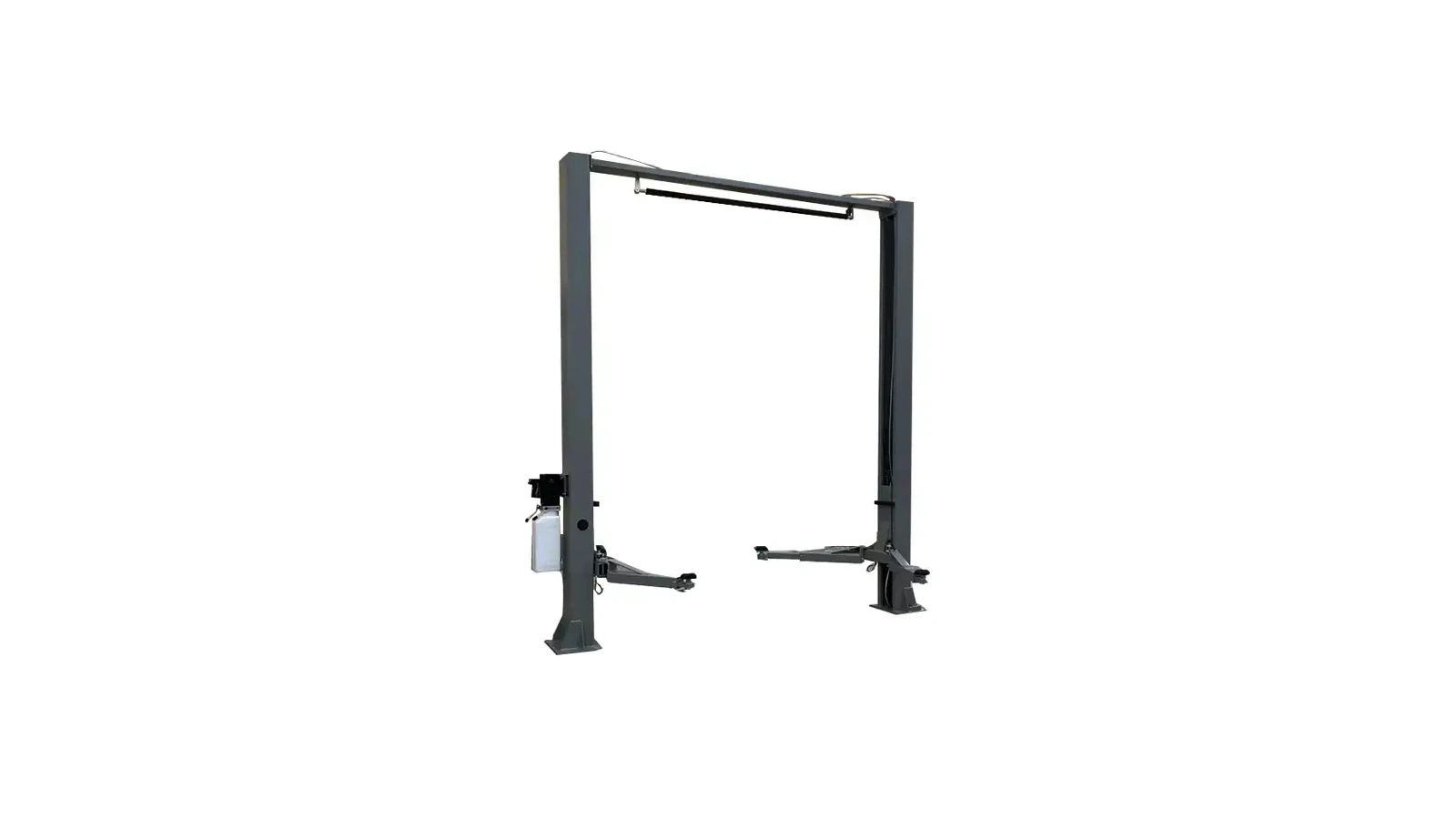
Chentuo lists a two-post hydraulic gantry lift for service stations. Identify that exact product and the installed power unit when requesting its oil requirements, rather than relying on the general phrase “hydraulic lift.”
The separately listed double-cylinder two-post vehicle lift is another configuration to distinguish in the inquiry. Neither the two-post structure nor the cylinder description establishes that both products use an identical oil or fill quantity.
Prepare a short technical record so the supplier can identify the equipment:
| Provide | Ask to confirm |
|---|---|
| Lift model, serial number and product reference | Applicable instructions and configuration |
| Power unit identification and any replacement history | Approved fluid type and complete specification |
| Expected workshop temperature range | Permitted viscosity and operating conditions |
| Existing fluid details and maintenance history | Top-up compatibility or approved replacement procedure |
| Current service task or symptoms | Required level-checking, filling or service instructions |
Frequently Asked Questions
Can I Use ATF in Any Two-Post Car Lift?
No. Use ATF only when the instructions for the exact lift and installed power unit permit the relevant specification. Approval on another lift does not establish compatibility with yours.
Does a Four-Ton Lift Need a Particular Oil Grade?
Capacity alone is insufficient. Confirm the hydraulic power unit, approved fluid specification and operating conditions. Do not select viscosity solely from the load rating.
How Often Should Lift Hydraulic Oil Be Changed?
Follow the equipment’s maintenance schedule and condition-assessment requirements. There is no single change interval established here for all Chentuo lifts. Contamination or abnormal operation calls for an appropriate service assessment, not just waiting for a calendar date.
Choose the Fluid for the Actual Equipment
The correct answer begins with the lift’s approved fluid requirement, then checks viscosity, temperature, compatibility and quantity separately. For a Chentuo unit, contact Chentuo with your lift and power unit details to confirm the applicable instructions. Keep the confirmed specification with the maintenance record so future servicing uses the same documented basis.