Tire Changer Assist Arms: When Do They Help and What Must Fit?
A tire changer assist arm helps control tire-bead and sidewall position during certain mounting and demounting operations, but it does not make every wheel compatible with the machine. Its value depends on where the contact tool reaches, how it is controlled, and whether it works safely with the changer’s turntable, clamps and mounting head. For a tire shop servicing low-profile or stiff-sidewall tires, an assist arm should be assessed as part of the complete machine—not as an isolated accessory.
Before ordering, compare the shop’s actual tire-and-rim combinations with the host machine’s approved clamping range, the assist arm’s horizontal and vertical travel, contact components and available workshop space. The objective is controlled bead positioning, not a claim that an arm prevents all rim damage.
What Does a Tire Changer Assist Arm Actually Do?
On a conventional changer, the clamping system holds the wheel, the bead-breaking system helps release the tire bead from its seat, and the mounting/demounting head manages the tire’s movement relative to the rim. An assist or helper arm provides an additional controlled contact point at the tire sidewall or bead area, depending on the approved attachment. It may help keep part of a stiff bead down where the wheel geometry requires it while the machine performs another operation.
This division of functions matters to purchasing. A helper arm is not a replacement for the main mounting head, the bead breaker or correct wheel clamping. Different machines use different rollers, pressure discs, hold-down devices and articulated arms. The words “assist arm included” alone do not identify the actual tools supplied.
Which Tires May Benefit from Assist-Arm Support?
Low-profile tires, some reinforced or stiff-sidewall designs and certain run-flat assemblies can make bead-position control more demanding. Whether a particular assembly needs assisted equipment depends on its tire and rim design and the approved service procedure. A rigid sidewall description is not proof that a specific helper arm is compatible.
For difficult assemblies, the relevant question is whether the arm can maintain the necessary bead position through the particular phase of work without obstructing the tool head or contacting the rim in an unintended way. Tire-pressure monitoring equipment, special wheel finishes and unusual rim profiles introduce further compatibility considerations. Follow the tire and wheel manufacturers’ handling requirements rather than assuming a generic tire changer demonstration applies to every assembly.
How Does Assist-Arm Geometry Determine Its Working Range?
Horizontal reach across the wheel
As rim diameter increases, the bead region lies at a different distance from the arm’s pivot and the machine column. Check that the approved pressure tool can reach the required position across the full intended rim range, not only a conveniently sized demonstration wheel.
Vertical travel and tire profile
Sidewall height, wheel width, inflation state during the approved service step and turntable height affect the needed vertical movement. A device may have enough horizontal reach but too little useful vertical adjustment for a difficult combination. Request the relevant dimensions and verify them on a representative assembly.
Contact head and clearance
The roller, disc or pressure pad must be suitable for its intended contact surface. Tool geometry should also leave sufficient room for the mounting head, wheel clamps, rim edge and any protruding features. A contact point that works on one wheel may interfere with another, even if both fall within the advertised rim-diameter range.
| Compatibility variable | Question for the supplier | Practical check |
|---|---|---|
| Rim diameter and width | What are the approved ranges for this exact configuration? | Test the smallest and largest relevant rim sizes |
| Horizontal reach | Can the tool reach the required bead position? | Inspect the full movement envelope |
| Vertical stroke | Is usable movement sufficient for the tire profile? | Confirm contact and clearance throughout motion |
| Contact tool | Which roller or pad is supplied and approved? | Check surface condition and intended use |
| Host machine | Is the arm factory-integrated or approved for retrofit? | Verify exact model and installation documents |
Why Must the Host Tire Changer Be Evaluated with the Arm?
The changer’s turntable or wheel-clamping arrangement establishes where the wheel sits. A tilt-back column changes the relative position of the mounting head and the accessible wheel area. The assist arm operates within that geometry. An arm mounted to a machine with a different column or clamp design may not have the same reach, control response or clearance.
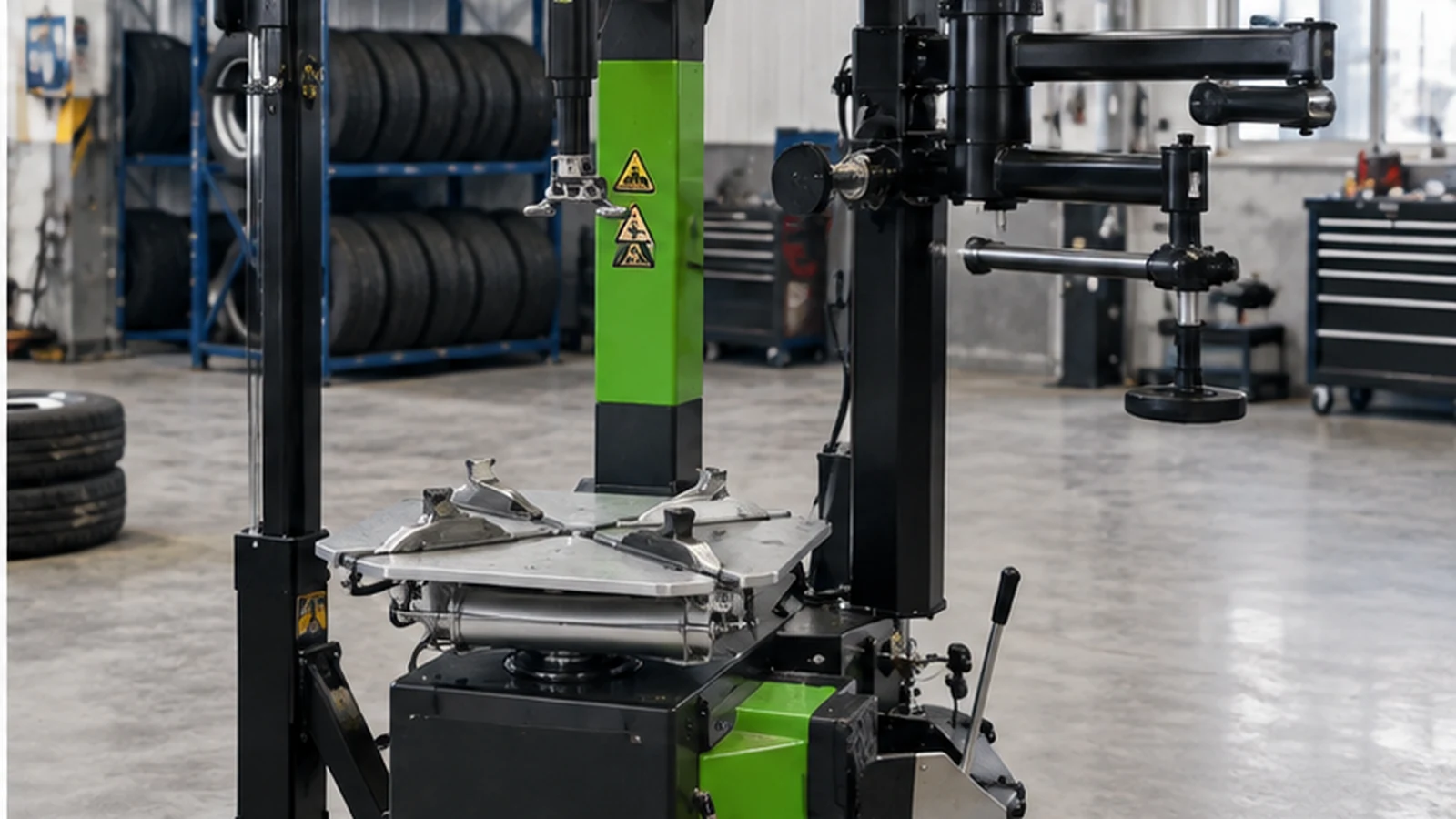
CHENTUO publishes an electric/pneumatic tilt-back post tire changer with assist arm. The listing identifies 220 V/380 V options and states size-related ranges of 12–24 and 13–24. It does not define all measurement conventions in the short description; these numbers must be checked against the actual inside/outside clamping specification and approved wheel range in the model manual. The same page references “3000KG tire force,” which should not be reinterpreted as the assist arm’s pressure or an allowable rim load.
What Can Go Wrong with Incorrect Assist-Arm Contact?
More force is not necessarily better. The wrong contact position may create concentrated loading or shift the bead in an unintended direction. A mispositioned pad can touch a rim edge, interfere with the mounting head or increase resistance during rotation. Excessive or poorly controlled pressure can also compromise a tire or wheel during a process that should be guided by manufacturer procedures.
For procurement and training, separate three risks: machine-to-wheel incompatibility, incorrect attachment positioning and inconsistent operator control. A device may be mechanically capable of reaching a position while that position is unsuitable for the tire being serviced. Ask for the complete approved service sequence and training instructions for the exact machine and accessory combination.
Which Utilities and Workshop Clearances Matter?
A machine with an integrated pneumatic arm needs the specified clean air supply and appropriate electrical installation. Published voltage options do not establish that both configurations are interchangeable without ordering the correct version. Confirm compressor pressure and flow, electrical frequency and connection, and the floor-installation instructions from the manufacturer.
The floor plan needs to include the full movement envelope of the helper arm and tilt-back column, not merely the footprint of the cabinet. Allow clear access for wheel loading and removal, technician controls and servicing the moving components. If the shop has low ceilings, adjacent lifts or closely spaced service bays, inspect the installed configuration’s swept area before purchase.
Factory-Integrated Assist Arm or Retrofit Kit?
An integrated arm is designed as part of a defined machine configuration. A retrofit accessory should only be considered when the equipment manufacturer approves it for the precise host model and supplies suitable installation instructions. A similar-looking bracket is not proof of compatibility: attachment points, column strength, pneumatic controls, travel stops and interference zones can differ across machines and production versions.
When comparing purchase options, evaluate the included contact tools, spare-part identification and service documents. The lower purchase price of an add-on is not meaningful if it cannot be verified for the installed changer or prevents the correct service procedure.
How Should a Workshop Trial the Assist-Arm Configuration?
A meaningful demonstration uses wheel assemblies representative of the difficult work actually performed. Staff should work under approved tire, wheel and equipment instructions, with appropriate protective measures. The evaluation is about controlled accessibility and equipment compatibility, not experimenting with uncontrolled force on customer wheels.
- Identify the workload: list rim diameters and widths, low-profile or reinforced tires, wheel finishes and special profiles.
- Confirm the machine: check the exact tilt-back or clamping configuration and its approved operating range.
- Inspect each contact tool: identify intended position and verify adequate clearance from the rim and mounting head.
- Observe the movement: assess reach, stroke, control sensitivity and operator visibility through the approved procedure.
- Review the result: inspect equipment and wheel contact areas as specified, record any interference and decide whether the configuration covers the workload.
Document any tire/rim combination that falls outside the approved test or manufacturer instructions rather than treating a successful trial of another size as evidence of universal compatibility.
What Should Equipment Buyers Include in an RFQ?
The purchasing brief should state tire and rim types, the size range, volume of low-profile or reinforced-tire work, existing tire changer model if a retrofit is being considered, and the workshop utilities. Request the precise host-machine model, the assist-arm configuration and tools included, approved compatibility documentation, installation clearances, air and electricity requirements, maintenance guidance and relevant service parts.
CHENTUO’s tilt-back assist-arm machine can be compared with those requirements; however, a general product claim such as “quick and easy changes” is not a substitute for a demonstration or the model-specific manual.
Frequently Asked Questions
Does an assist arm make every tire changer suitable for run-flat tires?
No. Suitability depends on the exact tire/rim combination, host-machine capabilities, approved tools and service instructions.
Can any helper arm be installed on an existing changer?
No. Retrofitting requires explicit compatibility with the host model and the manufacturer’s approved installation procedure.
Does a helper arm eliminate rim-damage risk?
No. Wheel positioning, contact-tool condition, control, technique and the approved service process remain important.
Final Assist-Arm Selection Considerations
Choose a tire changer assist arm by the work it must reach and control: the tire and rim profiles, the machine’s clamps and mounting head, the contact tool and available movement. For a configuration check, contact CHENTUO with your tire-size mix, rim specifications, workshop power and air supply, preferred machine version and estimated order quantity.