What Automatic Tyre Changer Specs Should Buyers Confirm?
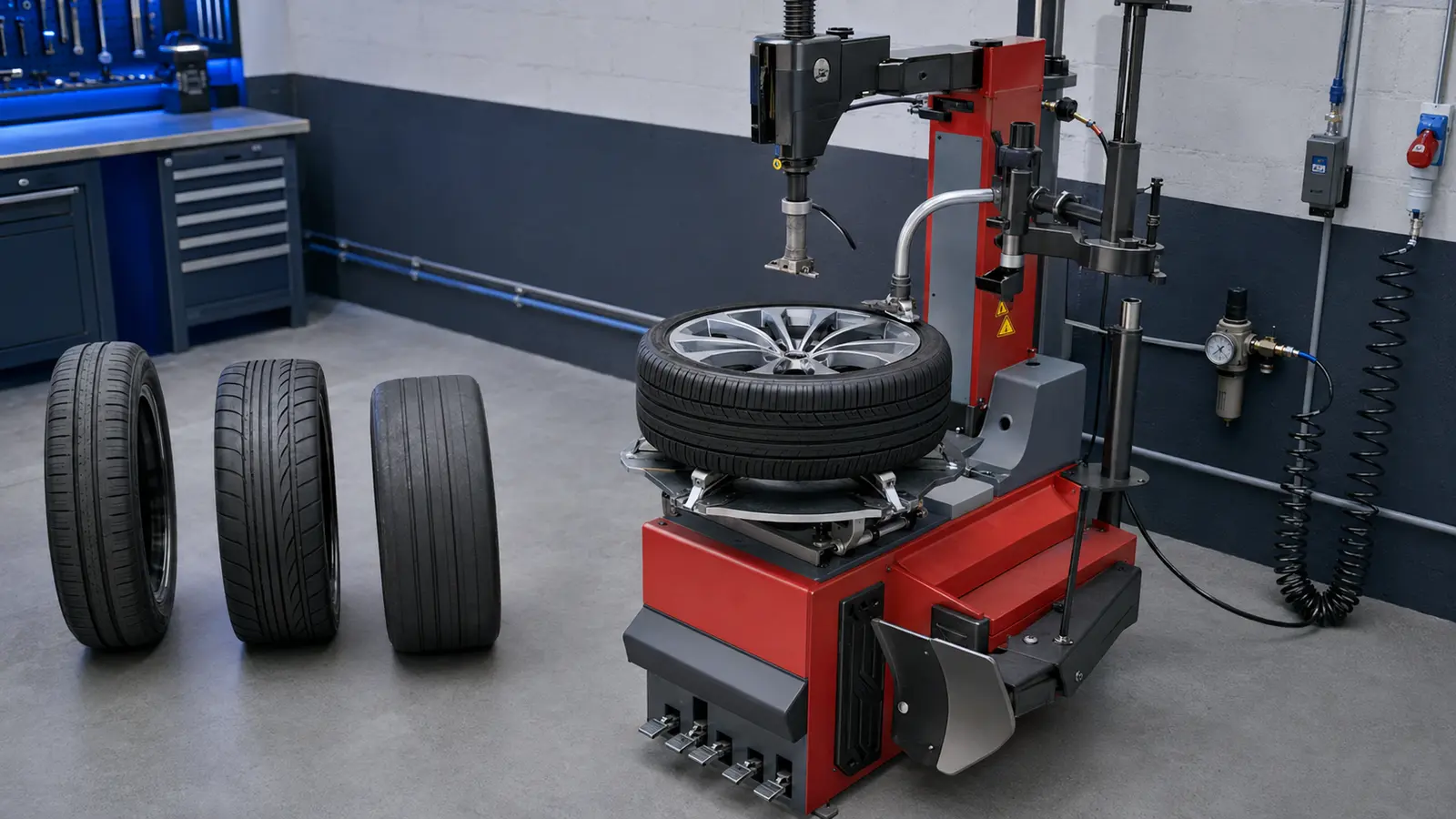
An automatic tyre changer specification should define the wheel and tyre range, clamping method, maximum tyre diameter and width, power supply, motor and turntable performance, compressed-air requirement, bead-breaker capacity, tool-head design, assist-arm functions, inflation system, footprint, accessories, acceptance checks, and service package. Buyers should not use “automatic” or “fully automatic” as a complete technical description because suppliers apply those terms to different functions. A comparable RFQ states the workshop’s tyre mix and utilities first, then asks each manufacturer to identify exactly which operations are powered, assisted, manual, optional, or excluded on the quoted model.
Define the workshop workload before choosing a machine
The correct tyre changer depends on the wheels processed every day. A general passenger-car shop, performance-tyre specialist, motorcycle dealer, fleet workshop, and truck service center need different clamping ranges, tool geometry, bead handling, and floor layouts. Buyers should list the current workload and the expected mix over the next several years rather than selecting from a single maximum-rim figure.
Useful application inputs include tyre construction, rim material, rim diameter, rim width, maximum tyre diameter, maximum assembly weight, low-profile frequency, run-flat frequency, reverse-mounted wheels, deep-drop-center wheels, motorcycle or ATV wheels, and expected jobs per day. The RFQ should identify the difficult assemblies that drive the specification, not just the average tyre.
A machine intended for passenger-car and light-truck wheels should not be assumed capable of heavy truck, agricultural, or earthmoving tyres. Those applications use different handling and clamping systems. If a distributor wants one catalogue to cover several market segments, each segment still needs a clearly matched machine family.
Clarify what the supplier means by “automatic”
The term can describe a tilt-back column, pneumatic locking, powered turntable, powered bead breaker, automatic tool-head movement, leverless bead lifting, assisted mounting, automatic inflation, or a programmed cycle. Two machines carrying the same label may therefore demand very different operator actions.
Ask the supplier to provide an operation sequence for clamping, bead breaking, demounting, mounting, and inflation. For each step, state whether the machine performs it automatically, under powered operator control, with an assist arm, or manually. A short operating video for the quoted model can support the written description, but it should not replace the technical data sheet and manual.
Automation should be evaluated against the workshop’s goal. A high-volume shop may prioritize repeatable cycle steps and reduced handling. A specialist working with stiff sidewalls may prioritize bead control and rim protection. A small workshop may value simple maintenance and utility compatibility more than a complex sequence.
Freeze the rim and tyre operating range
Buyers browsing the tyre changer product range should distinguish rim clamping range from overall tyre capacity. External and internal clamping ranges are not the same. Maximum rim diameter does not automatically prove that a machine can handle the tyre’s overall diameter, width, profile, or assembly weight.
The RFQ should request:
- external clamping range and internal clamping range, with units;
- supported center-clamp range where a center-clamp design is offered;
- maximum rim width, maximum tyre width, and maximum tyre diameter;
- maximum supported wheel-assembly weight;
- approved vehicle and tyre types, including any exclusions;
- special adapters required for motorcycle, reverse, closed-center, or unusual wheels;
- contact materials and protectors used on painted or alloy rims.
Ask the supplier to explain how the quoted range is measured. A nominal 10–26 in range, for example, may refer specifically to an external clamp position rather than every wheel the machine can process. The working range should be confirmed in the manufacturer’s technical data and operating instructions for the exact model.
Match clamping and tool-head design to rim risk
Rim-clamp machines grip the wheel at several jaw positions, while center-clamp designs secure the wheel through or around the center. Each approach has its own adapter, access, and protection considerations. The best choice depends on the workshop’s wheels and operator process; one clamping style is not universally safer for every application.
For jaw-clamp machines, request the jaw geometry, clamping range, replaceable protectors, operating pressure, and available motorcycle or specialty adapters. For center-clamp machines, confirm center-bore coverage, flange plates, cones, reverse-wheel adapters, and how torque is controlled. Any contact component that can mark a rim should be visible in the spare-parts and consumables list.
The mount/demount head can be metal with protective inserts, polymer, lever-assisted, or leverless. Buyers should identify which head is standard, what protectors are supplied, whether alternative heads are available, and which tyre and rim types they are intended to handle. “No rim damage” should not be accepted as an unconditional claim; correct setup, protected contact surfaces, lubrication, tyre condition, and operator technique remain important.
Confirm power supply beyond the voltage label
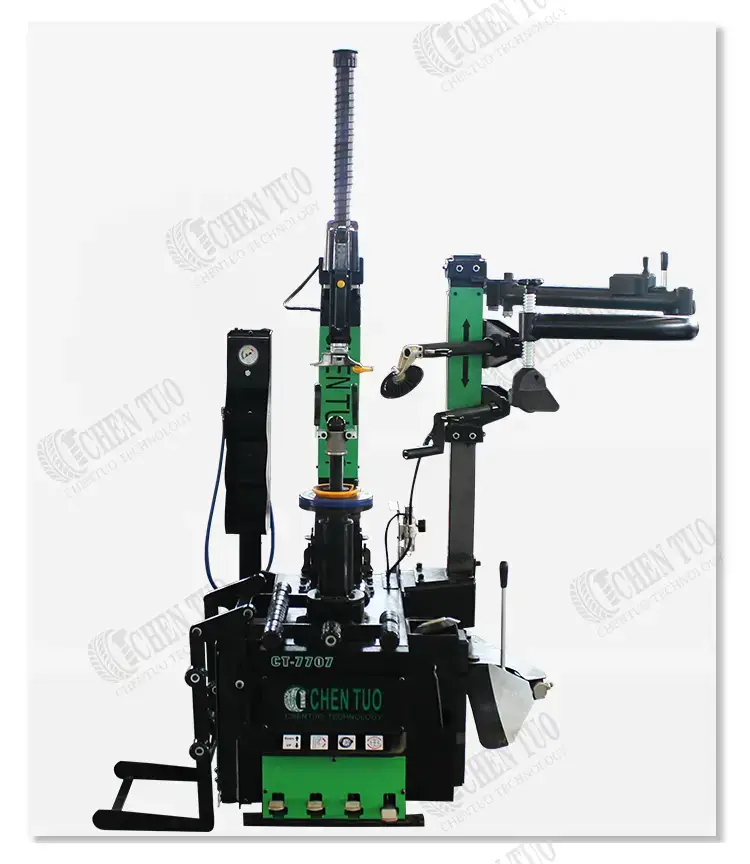
A voltage option is not a complete electrical specification. State the destination voltage, phase, frequency, plug or connection type, and available circuit. Ask the supplier to confirm motor rating, rated current, rotation direction, turntable speed or speeds, protection requirements, and whether the quoted machine is configured for the destination supply.
The CHENTUO CT-7707 automatic tyre changer is presented with 220 V and 380 V options. A buyer should still confirm phase and frequency, because a 220 V single-phase workshop supply is not equivalent to a 220 V three-phase supply, and 50 Hz and 60 Hz configurations may require different motor or component choices.
If the supplier offers multiple motor ratings or speeds, the quotation should identify the selected version. Distributors should also request destination-appropriate labels, wiring diagrams, operating manuals, and spare electrical parts for that exact configuration.
Verify compressed-air pressure, flow, and units
Tyre changers can use compressed air for clamping, column movement, bead breaking, assist arms, and inflation. A pressure value without air consumption or flow information does not tell the buyer whether the workshop compressor can support normal operation. The RFQ should state available pressure at the machine under load, compressor capacity, line size, connection, filtration, drying, and the number of machines sharing the air system.
Unit checking is essential. Bar, MPa, psi, and kPa are not interchangeable labels. A misplaced decimal or an incorrect unit can change the apparent pressure by a factor of ten. The buyer should require the quotation, data sheet, nameplate, regulator range, and manual to agree. If a web page and a technical document conflict, the supplier should issue a corrected, controlled specification before order confirmation.
Air quality also affects valves, cylinders, lubricators, and water accumulation. Ask for the required filtration, lubrication, drainage, and maintenance instructions. These utility conditions should be treated as installation requirements rather than discovered during commissioning.
Compare bead-breaker force and geometry correctly
Bead-breaking performance depends on more than a headline force. The shovel or roller must reach the bead at an appropriate angle, support the tyre without contacting the rim incorrectly, and operate within a controlled pressure range. Force may be stated in newtons, kilonewtons, kilogram-force, or another unit, so buyers should confirm both the value and the unit.
Request shovel width, opening range, cylinder or actuation method, control type, protective pads, and intended tyre range. For run-flat or low-profile work, ask how the machine controls the upper and lower beads during demounting and mounting. An assist arm can reduce manual effort, but its number of pressing points, travel, rotation, control, and tool attachments determine what it actually does.
Do not assume that a larger stated force always means better operation. Excessive or poorly controlled contact can increase the risk of tyre or rim damage. The useful specification combines adequate force, suitable geometry, controllability, and protection.
Specify the assist-arm configuration as individual functions
“Assist arm included” can refer to one roller, a pressing disc, a lifting hook, a bead depressor, multiple articulated arms, or a complete run-flat package. The quotation should list every attachment, its position, its powered or manual movement, and whether it is included in the base machine.
For difficult tyres, buyers can ask the supplier to demonstrate how the arm holds the bead in the drop center, protects the rim, lifts or guides the lower bead, and maintains control during turntable rotation. The demonstration should use a wheel type representative of the buyer’s workload. A promotional video with an easy standard tyre is not enough to validate a run-flat requirement.
If the assist arm is optional, confirm whether it can be retrofitted later, whether the cabinet and air system are prepared for it, and which spare seals, rollers, pads, and valves are needed.
Include inflation and bead-seating requirements
Some machines include a standard inflation hose, while others offer pedal-controlled inflation, a gauge, a storage tank, or bead-seating jets. Buyers should identify which system is required, the maximum controlled pressure, gauge units and accuracy expectations, safety restraints or procedures, and any destination requirements.
Bead-seating features require particular attention to the manufacturer’s operating instructions. High-volume air release and tyre inflation can create hazards when wheels are damaged, mismatched, improperly lubricated, or used outside the machine’s intended range. The RFQ should request the operating manual and safety labels in an appropriate language and should not substitute an accessory description for safe operating procedures.
Compare quotations with a controlled specification matrix
| RFQ field | Buyer input | Supplier return |
| Application | Vehicle types, rim materials, difficult tyres, daily volume | Supported applications, exclusions, expected operating sequence |
| Wheel range | Minimum and maximum rims, tyre diameter, width, weight | Internal/external clamp ranges and maximum tyre limits |
| Utilities | Voltage, phase, frequency, available air pressure and flow | Exact motor version, rated current, air pressure, consumption, connection |
| Bead handling | Run-flat, low-profile, reverse, and stiff-sidewall requirements | Tool head, bead breaker, assist-arm functions, standard adapters |
| Acceptance | Functional test, documents, labels, accessory verification | Test plan, report format, model identification, deviations |
| Commercial scope | Quantity, destination, delivery term, training and warranty needs | Included items, options, packing, lead time, warranty, spare parts |
Define pre-shipment acceptance and service support
Before shipment, the supplier should verify the exact voltage and model, controls, turntable rotation, clamping and release, bead-breaker movement, assist-arm functions, air leakage, regulator operation, inflation components, guards, labels, standard tools, optional accessories, and emergency or stop functions provided on the model. The buyer should agree whether the evidence will be a checklist, photographs, operating video, inspection report, or remote witness.
Documentation should include the operating and maintenance manual, wiring and pneumatic information appropriate to the product, parts list, troubleshooting guide, warranty terms, and package list. Distributors may also need editable or localized service materials, but these should be agreed rather than assumed.
After-sales scope affects the real purchase value. Confirm technical response channel, warranty start point, replacement-part process, remote diagnosis, training boundary, recommended spare kit, and availability of wear parts such as jaw protectors, tool-head inserts, seals, pedals, valves, rollers, and gauges.
What should buyers send with an automatic tyre changer RFQ?
Send a tyre and wheel matrix, difficult-application photographs where appropriate, expected daily volume, destination utilities, floor-space limit, preferred automation functions, required assist arms, inflation needs, quantity, destination, delivery term, documentation language, acceptance evidence, warranty expectations, and spare-parts requirement. Ask the supplier to return a completed specification matrix rather than a general catalogue.
Use Chentuo’s automatic tyre changer RFQ form to submit these details. Request that the quotation identify the exact CT-7707 electrical version, verified air requirement and units, clamping and tyre range, bead-handling configuration, standard accessories, optional items, packing, inspection evidence, and all technical deviations.
Frequently asked questions
Does “fully automatic” mean the whole tyre-changing cycle is unattended?
Not necessarily. The term may describe powered column, tool-head, clamping, or assist functions while the operator still positions the wheel and controls each step. Ask for a function-by-function sequence for the quoted model.
Is rim diameter enough to confirm machine compatibility?
No. Buyers also need clamping method and range, tyre diameter and width, assembly weight, rim profile, vehicle type, and required adapters. Internal and external clamping figures should be listed separately.
Why must air pressure and air consumption both be confirmed?
Pressure indicates the operating level, while consumption or flow indicates whether the compressor can maintain that level during clamping, bead breaking, assist-arm movement, and inflation. A shop may have adequate static pressure but insufficient flow when several machines operate.
What should happen if the web page and data sheet use different units?
The supplier should issue a corrected, controlled specification before the purchase order. The quotation, approved data sheet, nameplate, regulator range, and manual should use consistent values and units for the exact configuration.