What Custom Truck Wheel Balancer Details Should Buyers Confirm Before an RFQ?
A truck wheel balancer RFQ should define the wheels to be serviced before it asks for a machine price. The key inputs are vehicle and wheel type, maximum wheel diameter and weight, rim and center-hole range, mounting or adapter requirements, electrical supply, balancing workflow, display expectations, required documents and after-sales scope. These items determine whether two quotations describe the same usable configuration. For a customized LED truck wheel balancer request, the word “customized” should be converted into specific, checkable requirements rather than left as a general preference. A supplier should be able to return each critical item as confirmed, optional, alternative or requiring buyer clarification.
Start the RFQ With the Actual Truck and Wheel Range
“For trucks” is not a complete application specification. A tire shop may service light commercial vehicles, rigid trucks, buses, trailers or a mixed fleet, and those wheel populations can differ significantly in diameter, mass, rim construction and mounting interface. The first RFQ step is therefore to describe the wheel range the workshop actually expects to balance.
At minimum, provide the largest and most common wheel assemblies, not only a vehicle label. Maximum wheel diameter and maximum wheel weight answer different questions. Diameter affects physical clearance around the spindle, hood and cabinet area, while wheel weight affects handling, mounting and the load the machine must support during balancing. Rim diameter is another separate value; a buyer should not assume that a machine accepting a certain overall wheel diameter automatically accepts every rim size within that envelope.
For product-family evaluation, Chentuo groups its balancing equipment under the Wheel Balancer category. The category provides a useful starting point for comparing machine types, but the final selection still depends on the actual wheels entering the workshop.
A practical RFQ should also include representative high-volume wheels rather than specifying only the largest wheel in the fleet. A machine may technically accommodate the maximum size yet still be inconvenient if normal daily wheels require a different mounting sequence or additional adapters. The target is not simply to find a balancer that accepts the largest wheel; it is to establish a repeatable workflow across the wheel sizes that generate most of the workshop’s balancing work.
Wheel Capacity and Mounting Compatibility Must Be Checked Together
Capacity data is meaningful only when the wheel can be centered and secured correctly on the machine. This is why wheel size and weight should be considered together with center-hole information, rim type and required mounting accessories.
For mixed-brand truck or bus service, identify any wheels that use unusual center bores, mounting arrangements or specific adapter requirements. Ask the supplier to state which mounting components are included in the standard configuration and which need to be ordered separately.
This distinction matters because maximum wheel weight does not mean compatibility with every wheel below that weight. A wheel can fall inside the machine’s load range while still requiring a cone, flange plate, spacer or another centering solution that is not included in the quotation.
If mounting scope is missing from the RFQ, two machines with similar headline specifications may offer very different levels of workshop readiness. One quotation may include the necessary mounting accessories while another assumes they will be purchased separately.
The supplier response should therefore identify the standard mounting set and separately list application-specific adapters. Buyers do not need to prescribe the supplier’s complete mounting design, but they should request enough information to verify that representative wheels can be properly centered and secured.
For repeat orders, the approved accessory package should also become part of the controlled purchasing configuration. This reduces the risk of a distributor reordering the same machine later but receiving a different mounting package.
Do Not Specify Only “220V” for the Electrical Requirement
Electrical compatibility is another area where apparently similar quotations can hide important differences. Voltage alone may not completely define the required installation.
The RFQ should state the available voltage, phase and frequency at the workshop, together with any plug or connection requirements that are relevant to the destination market. If equipment will be distributed to several countries, the electrical specification should be listed by destination rather than described as one generic export configuration.
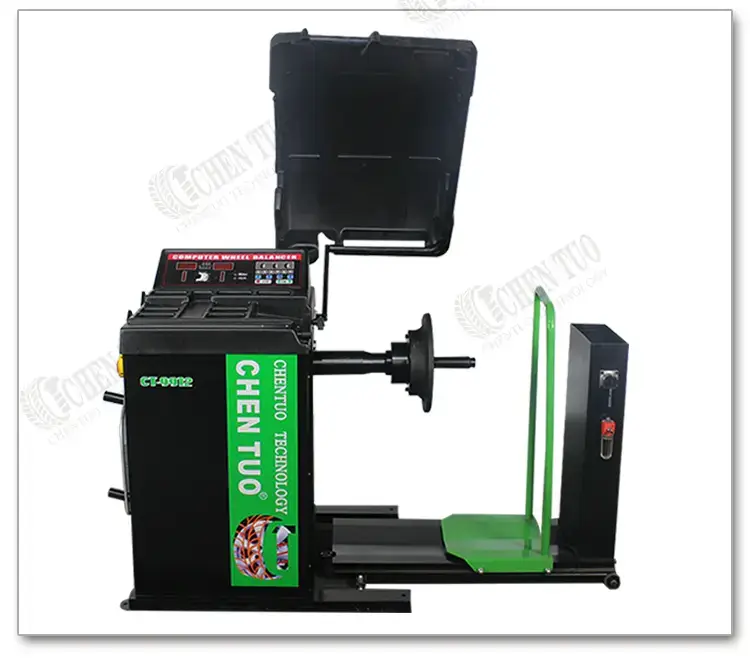
Chentuo’s automatic truck and bus wheel balancer is listed with a 220V configuration. Buyers considering this model should still compare that configuration with the electrical supply available at the actual installation site.
For distributor orders, it is also useful to clarify whether different destinations require different plugs, labels, documentation or electrical versions.
An incomplete electrical specification may not prevent a quotation from being issued, but it can leave an installation problem unresolved until the machine reaches the end user. The better approach is to freeze the electrical requirement before comparing prices and require the supplier to repeat the offered electrical configuration in the quotation.
Balance Cycle Time Is Only One Part of Workshop Throughput
Balancing time is easy to compare, which is why it often receives disproportionate attention during sourcing. In a truck workshop, however, the measurement cycle is only one part of the total service process.
A heavy wheel must be moved to the machine, positioned, mounted and centered before measurement begins. After imbalance is identified, the operator still has to install correction weights, verify the result when required and remove the wheel.
The Chentuo truck and bus wheel balancer referenced above lists a 7-second equilibrium specification, a 1200 mm maximum wheel and a 150 kg load capacity. These figures provide useful evaluation points, but they should not be interpreted as total wheel-service time.
The RFQ should instead ask how the proposed configuration supports the complete balancing workflow. Relevant questions include how the wheel is mounted, what information the operator must enter, which balancing functions are available for the intended wheels and how correction positions are communicated to the operator.
If high daily throughput is the reason for purchasing the machine, state that operating requirement in the RFQ. A fleet workshop handling relatively consistent wheel types may prioritize a repeatable process and straightforward operation. A distributor supplying different repair shops may place greater value on wider wheel and adapter coverage.
As a result, two buyers can evaluate the same wheel balancer differently even when the nominal capacity is identical.
Define What “Customized LED” Actually Means
The phrase “customized LED truck wheel balancer” can create ambiguity if the required customization is not explained. “LED” may refer to the display style, operator indicators or simply the buyer’s description of the control interface.
Rather than relying on the keyword alone, convert the requirement into functions that can be confirmed in a quotation. For example, identify whether the workshop needs a particular display format, clearly visible position indicators, specific measurement units, interface language requirements or other control preferences.
If a distributor also requires branding, cabinet appearance, labeling or other OEM presentation changes, those requests should be separated from the technical balancing configuration.
This separation improves quotation accuracy because technical requirements and commercial presentation requirements affect different parts of the offer. The technical configuration determines whether the balancer is suitable for the intended workshop. Branding or presentation changes define additional commercial scope.
When both are hidden inside a general request for a “customized” machine, it becomes difficult to identify why two supplier quotations differ.
Connect Product Specifications to the Actual Application
A product specification becomes useful only after it is connected to the wheel population and working conditions of the buyer.
For example, a 1200 mm maximum wheel specification should be compared with the largest complete wheel assemblies that will actually enter the workshop. The 150 kg load capacity should be checked against complete wheel weight rather than estimated from tire size alone. The 220V configuration needs to match the electrical conditions at the destination.
Mounting compatibility still requires separate confirmation. A wheel may be below both the size and weight limits while requiring an adapter that is not included in the standard package.
This creates a straightforward procurement chain:
Actual wheel population → required capacity and mounting interface → offered machine configuration → accessories or electrical deviations → quotation decision.
If an application falls outside the published product data, the buyer should not assume that an unlisted configuration is automatically available. Instead, request an alternative configuration from the supplier or require the limitation to be clearly declared before the quotation is approved.
Build the RFQ So Competing Quotations Are Actually Comparable
| RFQ Field | Buyer Input | Why It Matters | Supplier Response to Request |
|---|---|---|---|
| Vehicle and wheel scope | Truck, bus, light commercial vehicle or mixed fleet; representative wheel assemblies | Defines the real application instead of relying on a generic “truck” description | Confirmed application scope and proposed machine configuration |
| Wheel envelope | Maximum and common wheel diameter, rim range and complete wheel weight | Determines whether the machine accommodates the required wheels | Supported range and declared limitations |
| Mounting interface | Center-hole dimensions, wheel types and known adapter requirements | A wheel within the capacity range is still unusable if it cannot be centered correctly | Standard mounting hardware and optional adapters |
| Electrical supply | Voltage, phase, frequency and destination requirements | Prevents installation or commissioning conflicts | Offered electrical configuration and assumptions |
| Balancing workflow | Typical wheel mix, workload and operating requirements | Separates nominal balance-cycle time from practical workshop workflow | Relevant functions and operating process |
| LED/display requirements | Display behavior, indicators, units, language and OEM requirements | Converts a vague customization request into measurable quotation scope | Standard feature, option, alternative or deviation |
| Documents and after-sales | Manuals, calibration information, parts documentation and warranty requirements | Defines the support and documentation required after delivery | Document scope, warranty scope, spare-parts support and exclusions |
This comparison works only when every supplier responds to the same requirement set. Two quotations should not be considered technically equivalent simply because both products are described as truck wheel balancers.
Before comparing price, normalize the machine configuration, supported wheel range, mounting accessories, electrical requirements and documentation scope. Commercial comparison becomes much more meaningful after the technical scope has been aligned.
After-Sales Evidence Should Be Specific Enough to Verify
“After-sales support available” is too broad to function as a purchasing requirement. An RFQ should identify what the distributor or workshop expects after delivery and ask the supplier to define the corresponding scope.
For a distributor, relevant items may include operating instructions, calibration procedures, troubleshooting information, spare-parts identification and written warranty terms. For a workshop, practical questions may focus on how the machine is calibrated, what the operator needs to check and what information should be provided when technical support is required.
The Chentuo truck and bus wheel balancer referenced in this article is presented with a 12-month warranty. Before comparing that warranty with another offer, buyers should confirm what the warranty covers, when the warranty period begins, whether exclusions apply and how replacement parts or technical support are handled.
A warranty duration without a defined warranty scope does not provide enough information for a meaningful supplier comparison.
Calibration information deserves similar attention. Rather than accepting only a general accuracy statement, request the relevant operating or calibration instructions and verify what procedure the operator should follow when balancing results need to be checked.
When Does This RFQ Logic Change?
This procurement approach is intended primarily for off-vehicle truck and bus wheel balancing equipment used by repair workshops, fleet service operations and automotive equipment distributors.
It should not be transferred unchanged to passenger-car-only wheel balancers, on-vehicle balancing systems or projects where the buyer has already issued a controlled equipment specification containing mandatory interfaces and acceptance requirements.
The decision also changes when the actual wheel population exceeds the selected machine’s size, weight or mounting range. In that situation, the correct response is to select another configuration or machine rather than treating the limitation as a minor quotation deviation.
Electrical destination is another important boundary. A configuration suitable for one market should not automatically be assumed suitable for another location simply because both are informally described as using similar voltage.
For multi-country distribution, configuration control becomes especially important. Purchase documentation should identify the approved electrical version, accessory package, document language and accepted customization items so that repeat orders can be compared against the same technical baseline.
What Should the Final Truck Wheel Balancer RFQ Contain?
- Target vehicle classes and representative wheel assemblies.
- Maximum and normal wheel diameter, complete wheel weight and required rim range.
- Center-hole or mounting information for wheels requiring specific cones or adapters.
- Available workshop electrical supply, including voltage, phase and frequency.
- Expected balancing workflow and required operator functions.
- A precise description of the requested LED or display function rather than the keyword alone.
- Standard mounting accessories that must be included and optional adapters that should be quoted separately.
- Operating, calibration and troubleshooting documentation required with the machine.
- Warranty scope and after-sales or spare-parts information required by the buyer.
- Distributor or OEM presentation requirements separated from the technical configuration.
- A supplier response identifying confirmed items, options, deviations, assumptions and buyer inputs still required.
Once these requirements are defined, the application and proposed configuration can be submitted through Chentuo’s project inquiry form.
The quotation should repeat the proposed machine configuration, supported wheel range, electrical version, included mounting accessories, documentation scope and any declared deviations. This creates a clear technical purchasing record before the commercial decision is made and prevents “customized LED truck wheel balancer” from remaining an undefined requirement.