Why Do 10,000 lb Car Lift Price Quotes Differ?
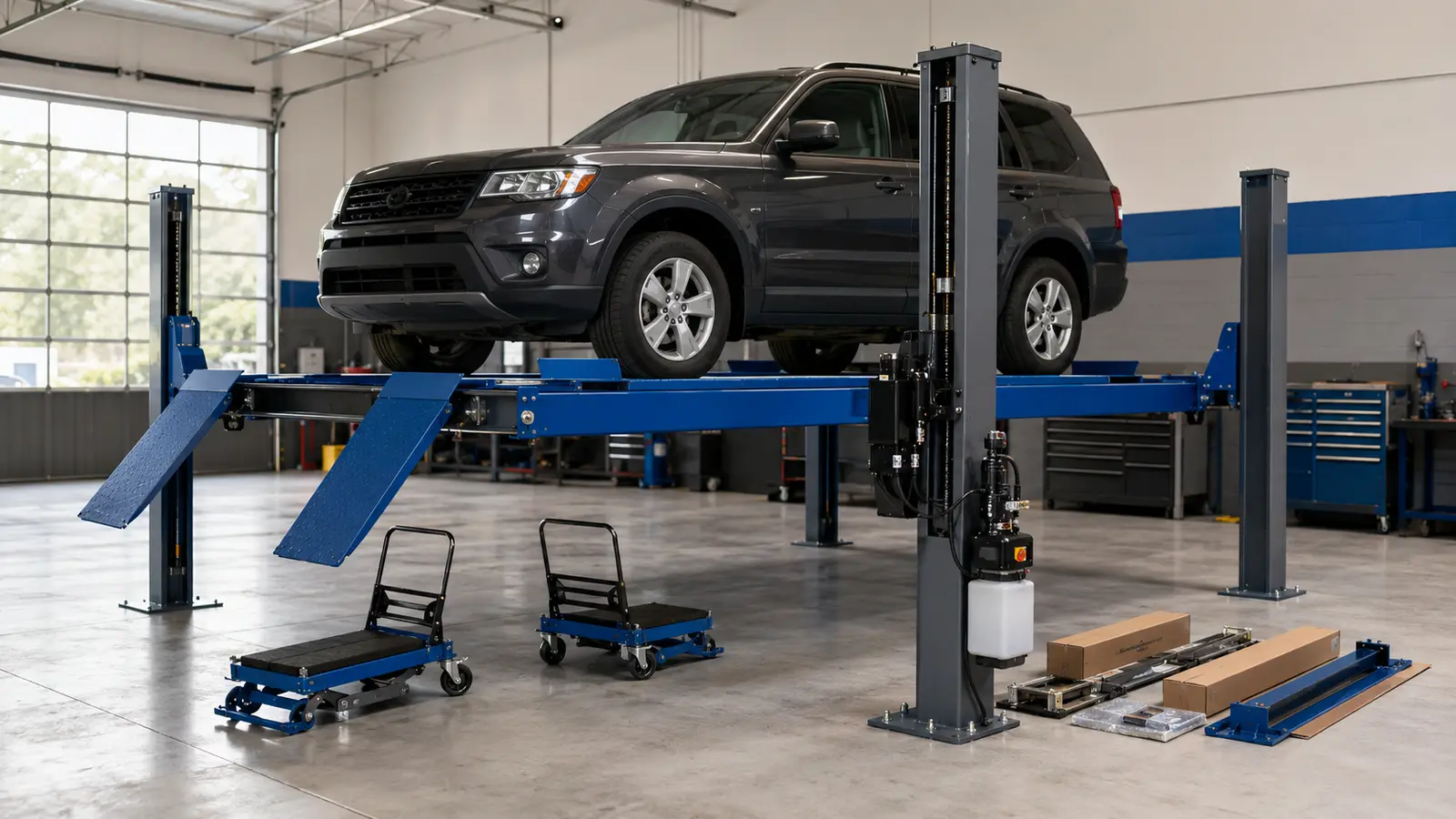
A 10000 lb car lift price can differ substantially because suppliers may not be quoting the same rated capacity, lift structure, runway package, power unit, safety configuration, accessories, installation scope, documentation, packing, freight basis, or after-sales support. The first step is to convert the buyer’s requirement into one controlled specification and ask every supplier to price the same boundary. A low equipment-only figure cannot be compared directly with a quotation that includes rolling jacks, alignment components, delivery, installation, commissioning, and local compliance documents. Buyers should compare the complete installed and accepted package, not only the number shown beside the lift model.
Start by defining what “10,000 lb” means
The rated load capacity must be clear before any price comparison begins. Ten thousand pounds is approximately 4.54 metric tonnes. It is not identical to either a 4 t or a 5 t model. A 4 t lift is below that nominal class, while a 5 t lift is above it. Suppliers may round capacities for marketing, translate units differently, or quote an available model that is close to the requested rating. The buyer should require the capacity shown on the nameplate, technical data sheet, quotation, and order confirmation to match.
Capacity alone is also incomplete. The vehicle’s total weight, wheelbase, track width, axle loads, center of gravity, and intended service work affect lift selection. A vehicle can be below the total rated capacity while its weight distribution or dimensions do not suit a particular runway, arm, or accessory arrangement. The lift must fit the actual vehicle population and the manufacturer’s stated loading conditions.
Do not mix two-post, four-post, scissor, and parking-lift prices in the same comparison. Each architecture uses a different load path, foundation interface, access pattern, safety system, and installation method. Marketplace listings may group them under the same capacity class, but they are not interchangeable procurement items.
Separate equipment price from project price
An equipment price normally covers the lift and a stated standard configuration. A project price may also cover site review, foundations, unloading, assembly, electrical connection, hydraulic setup, commissioning, operator handover, documentation, and travel. The quotation should state which items are included, excluded, or supplied by the buyer.
This distinction is especially important for imported workshop equipment. A supplier can quote ex-works equipment, FOB export packing, CIF delivery, or another commercial basis. Those figures allocate transport cost and risk differently. A workshop that compares them as if they were delivered-and-installed prices may choose the apparent low quote and discover major costs after the purchase order.
| Quotation layer | Items to confirm | Typical comparison error |
| Base lift | Exact model, rated capacity, structure, power unit, standard safety devices | Comparing different lift types or capacity versions |
| Workshop fit | Runway dimensions, rise, overall footprint, ceiling clearance, electrical supply | Assuming a lift that fits the vehicle also fits the building |
| Accessories | Rolling jacks, turntables, slip plates, ramps, drip trays, wheel stops, lighting | One supplier includes options that another lists separately |
| Installation | Foundation review, unloading, assembly, anchoring, connection, commissioning | Treating equipment-only and installed prices as equivalent |
| Delivery | Packing, inland freight, port charges, ocean freight, insurance, destination handling | Comparing different Incoterms or delivery points |
| Lifecycle support | Warranty boundary, spare parts, remote support, manuals, service response | Ignoring the cost of downtime and unavailable parts |
Freeze the lift geometry before comparing prices
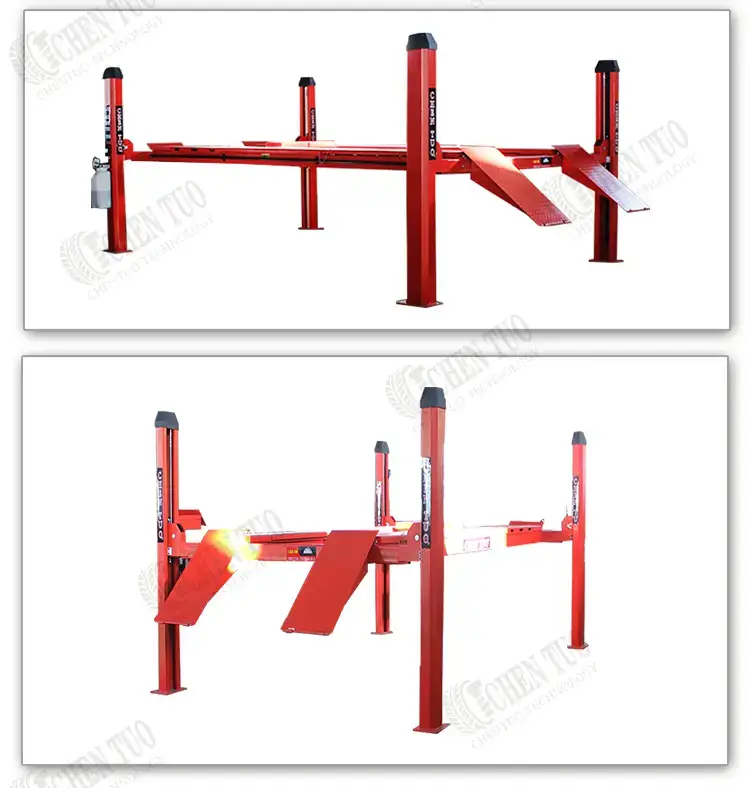
Buyers reviewing the car lift product range should first match the lift structure to the work performed in the bay. A four-post lift supports a vehicle through its tyres on runways and is commonly considered for inspection, alignment, long-wheelbase vehicles, or drive-on convenience. A two-post lift supports the vehicle at designated lifting points and can provide different underbody access. A scissor lift has its own access, floor, and installation characteristics.
For a four-post quotation, confirm usable runway length and width, distance between runways, drive-through width, minimum and maximum lift height, approach ramp length, overall dimensions, and whether the layout supports the target wheelbases. If alignment work is planned, specify turntable recesses or plates, rear slip plates, levelling expectations, and the rolling-jack arrangement. The word “alignment lift” should not replace this dimensional checklist.
For a two-post quotation, buyers would instead examine arm reach, pad configuration, column spacing, overhead or base-plate layout, drive-through clearance, and vehicle lifting-point coverage. These differences explain why secondary search phrases about two-post lift cost should not be used to estimate a four-post project.
Check power, hydraulics, locks, and controls as a package
Voltage alone does not define the electrical configuration. The RFQ should state voltage, phase, frequency, available circuit, plug or hard-wired connection requirement, and local electrical expectations. The supplier should identify motor and power-unit data, control voltage where relevant, and the buyer-side connection boundary.
Hydraulic and mechanical safety details also influence cost. Buyers should compare cylinder arrangement, hose routing and protection, synchronization method, mechanical locking positions, lowering controls, emergency-lowering provisions, runway or platform locks, and required periodic inspection points. The quotation should identify standard equipment and optional upgrades rather than using a general statement such as “complete safety system.”
Certification claims require model-specific evidence. A standard may cover lift construction and validation, installation and service, or operation and maintenance; those scopes are not interchangeable. Requirements also vary by destination market. If certification or listing is mandatory, request the exact model, certificate or listing reference, issuing body, applicable edition, and any installation conditions. Do not assume a factory certificate for one model covers every capacity and configuration.
Use the representative product page without erasing its capacity options
The CHENTUO CT609 four-post car lift is presented with 4 t and 5 t capacity options and a stated maximum lift height of 72.8 in. This makes it a relevant product reference for a buyer researching the approximate 10,000 lb class, but it does not make both versions identical to a 10,000 lb specification.
The RFQ should name the selected capacity version and ask the supplier to return the corresponding data sheet, dimensions, standard accessories, and nameplate information. If the buyer’s minimum requirement is 10,000 lb, the 4 t version would not meet that numeric threshold. The 5 t version exceeds it, but the buyer still needs to confirm vehicle fit, installation conditions, and the exact rated-load definition.
This simple capacity check prevents a common quotation problem: two suppliers appear to offer the same class of lift, but one has priced a lower-capacity or less-equipped variant.
Accessories can change both price and workshop function
Four-post lifts are often quoted with different accessory packages. Rolling bridge jacks may be required to lift wheels clear of the runways. Alignment work may require turntables, slip plates, and levelling features. Workshops may also request longer ramps, caster kits, drip trays, wheel chocks, jack trays, or lighting. Each item should appear as standard, optional, excluded, or buyer-supplied.
The buyer should also confirm the rated capacity of each load-bearing accessory. A lift’s main capacity does not automatically apply to a rolling jack or other accessory. The interface between accessory and runway matters as well; an accessory offered by another supplier should not be assumed compatible without dimensional and load verification.
When comparing packages, calculate the cost of the configuration needed for the intended work. Removing essential accessories to reach a lower headline price can produce a lift that cannot perform the planned services after installation.
Installation conditions can outweigh the equipment discount
The building and floor must be reviewed before order confirmation. Relevant inputs include bay dimensions, ceiling height, door position, vehicle approach, floor condition, slab details, embedded services, drainage, nearby equipment, electrical supply, and unloading access. The lift manufacturer’s installation instructions and destination requirements should govern the final foundation and anchoring decision.
A quotation should state whether the supplier reviews site information, supplies anchor hardware, provides installation drawings, sends technicians, supervises a local installer, commissions the equipment, or provides remote guidance only. It should also state who supplies lifting equipment for unloading and assembly. Vague phrases such as “installation support included” are not enough.
For international orders, travel, visa, local transport, accommodation, interpretation, consumables, and local labour may be excluded even when a technician is available. Buyers should put these boundaries in the commercial comparison rather than resolving them after shipment.
Compare packing and delivery on the same commercial basis
A lift is a heavy, multi-piece shipment. Packing method, corrosion protection, component identification, hardware segregation, document pouch, gross dimensions, gross weight, and loading plan affect both freight and receiving risk. Ask whether the quote uses a steel frame, wooden case, pallet, or another method, and whether the destination has wood-packaging requirements.
The commercial offer should identify the Incoterm, named place or port, estimated package count, transport mode, validity period, and items excluded at destination. Freight quotes can change with route, season, fuel charges, or carrier capacity, so buyers should separate time-limited logistics estimates from the equipment price.
Also confirm who handles loss or damage claims under the quoted delivery term and what evidence is required at receipt. Photographs before packing, package markings, and a detailed packing list can make receiving inspection more effective.
Define acceptance and after-sales support before the purchase order
A low quote may provide only basic shipment inspection, while another includes a documented functional test, nameplate check, accessory verification, manuals, spare parts list, and commissioning records. Buyers should define the required pre-shipment evidence and site acceptance steps in the RFQ.
Warranty comparisons should cover duration, start point, included components, labour, travel, freight for replacement parts, exclusions, claim evidence, and response channel. Ask for a recommended spare-parts list, consumables, hydraulic seals, electrical parts, locks, cables, hoses, and other service items appropriate to the exact model. The useful question is not only how long the warranty lasts, but how the workshop returns the lift to service.
What should buyers send for a comparable car lift quotation?
Send every supplier the same RFQ sheet. Include target rated capacity in both pounds and metric tonnes, vehicle types and weight range, wheelbase and track range, intended work, lift architecture, required runway and lift dimensions, bay drawing, floor information, power supply, required accessories, destination standard or listing requirements, packing method, delivery term, installation responsibility, commissioning scope, documentation, warranty, spare parts, quantity, and destination.
Ask the supplier to return the exact model and capacity version, compliance exceptions, dimensioned layout, utility requirements, standard and optional items, site-preparation boundary, inspection plan, package data, delivery basis, lead-time assumptions, warranty terms, and quotation validity. Deviations should be visible in the offer rather than buried in later correspondence.
Buyers can send this information through Chentuo’s car lift project enquiry form. A complete project brief allows the supplier to separate the base CT609 configuration from accessories, site services, export packing, freight, and after-sales scope, producing a quotation that can be compared on a like-for-like basis.